
Last updated October 16, 2026
 Wrought iron
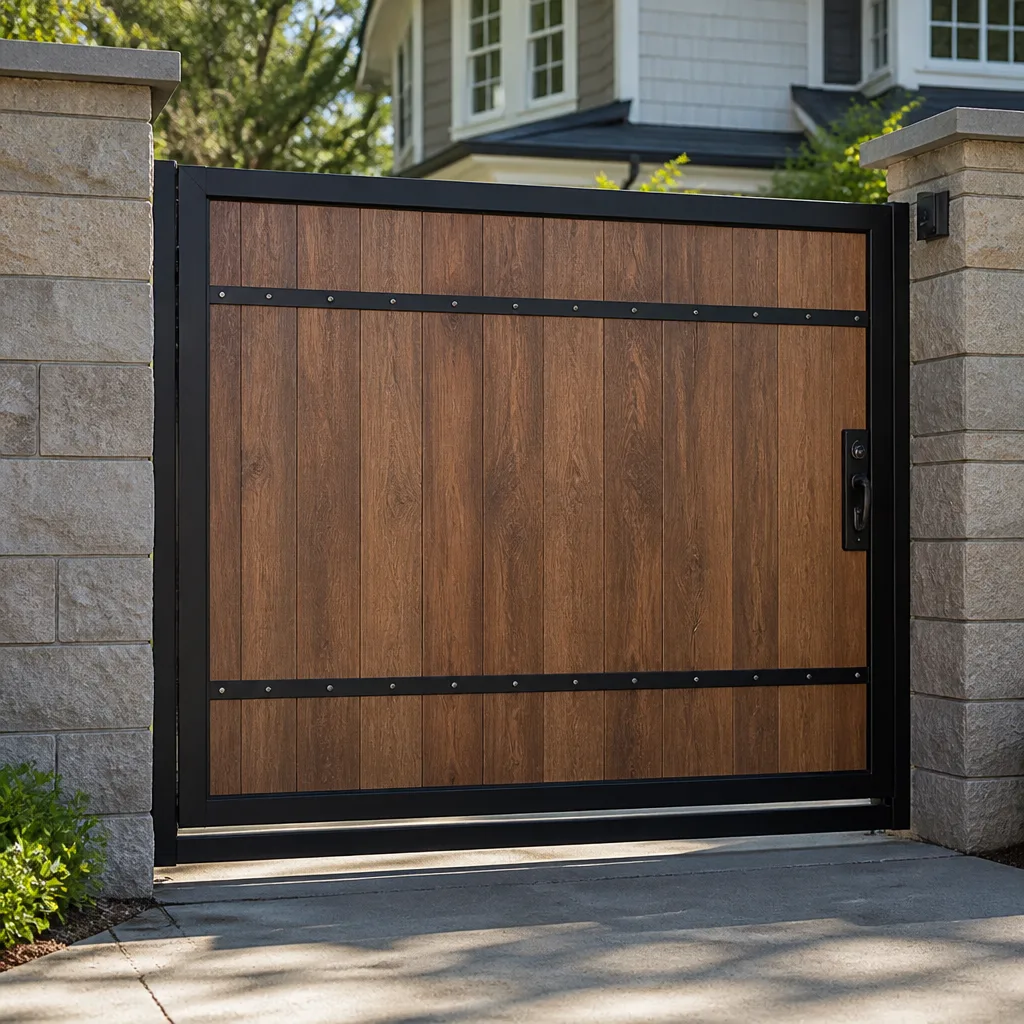 Wood & steel frame
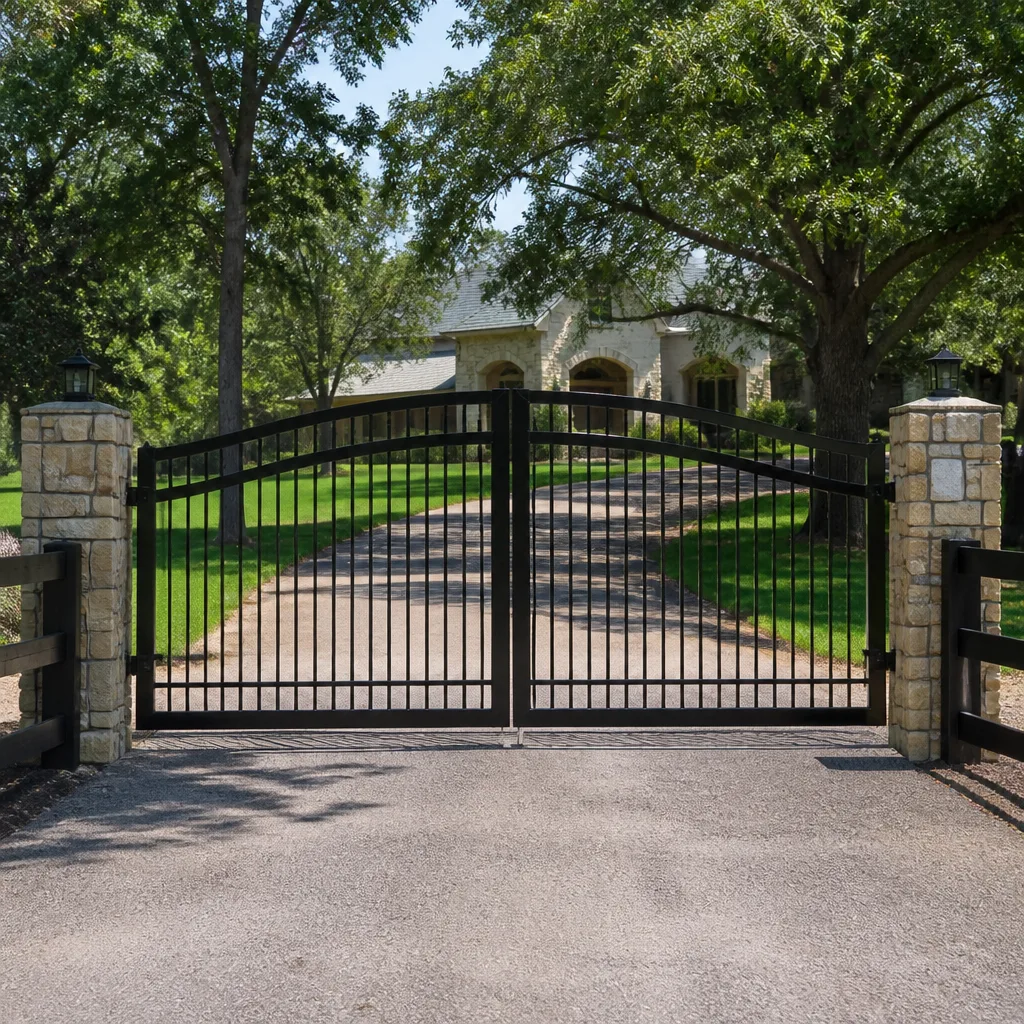 Farm & ranch
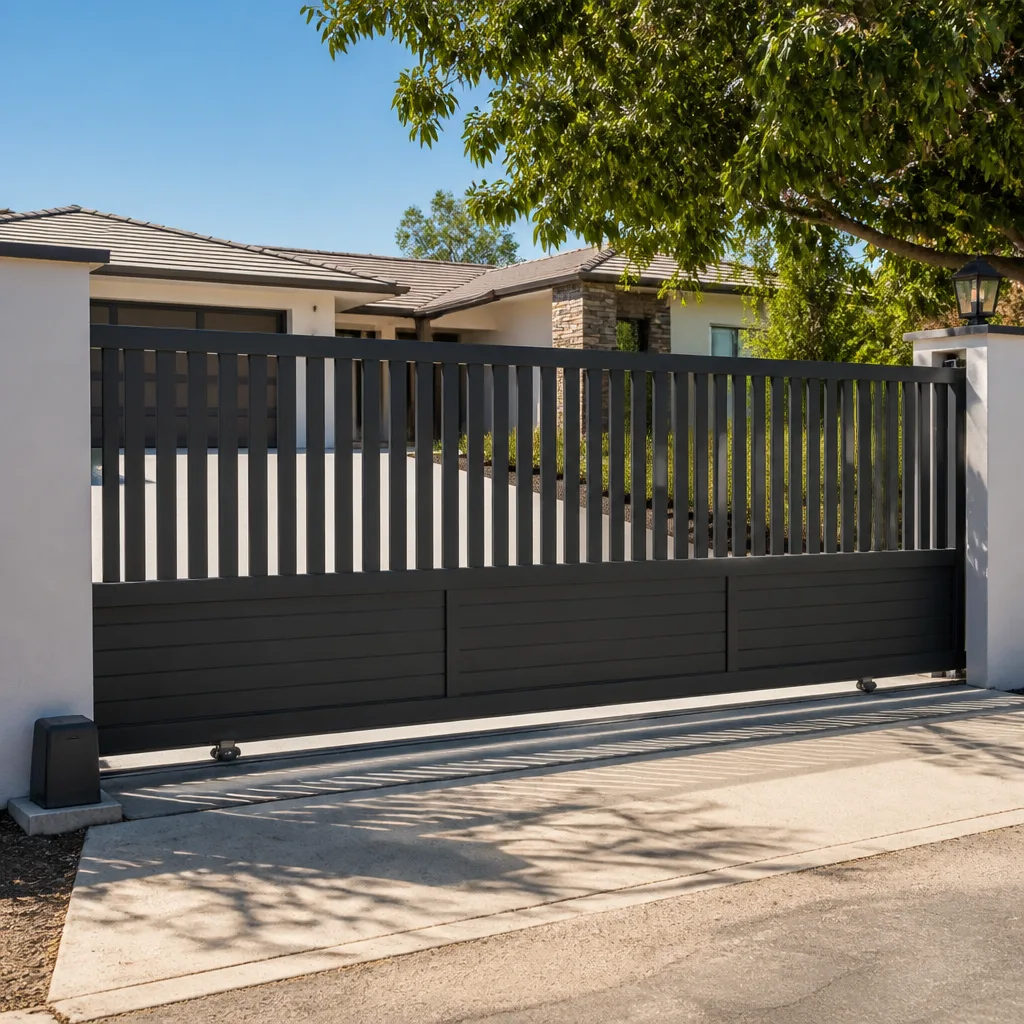 Sliding driveway gates
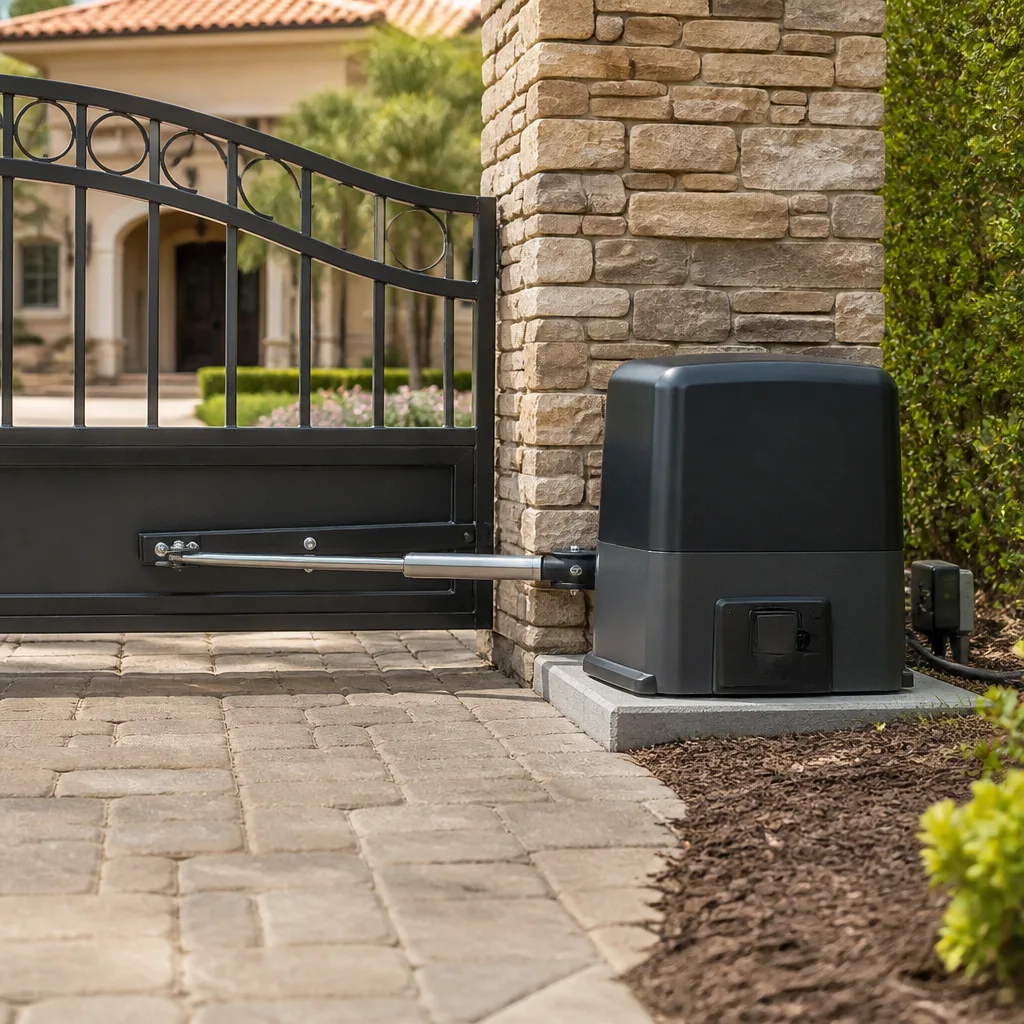 LiftMaster operators
Free on-site gate assessment - hinges, posts, and your LiftMaster or Nice gate operator checked before anything is quoted
The assessment is free and the quote is the invoice.
Get your free estimateGate Repair Warning Signs: A Las Vegas Homeowner’s Reference Guide
A gate that hesitates for two seconds before moving isn’t “warming up” – in Las Vegas heat, that pause is the motor’s thermal protection engaging, which means the motor is already running hotter than its design rating. This guide covers the warning signs specific to Las Vegas gates, why desert conditions create failures national guides never mention, and the three signs homeowners most often dismiss that turn into the most expensive gate repair jobs. By the time you finish reading, you’ll know what to check, what to ignore, and when to stop operating the gate entirely.
Quick Answer
The three warning signs Las Vegas homeowners most often dismiss are a two-second startup hesitation (thermal overload), a grinding sound that gets worse in dust season (contaminated drive gear), and a gate that works in the morning but balks at noon (heat-related sensor drift). In Las Vegas, these three symptoms are the earliest indicators of motor, gear, and sensor failures that typically cost between $180 and $900 to fix, compared to $1,200 to $4,000 for a full opener replacement if the problem is ignored. If your gate makes a sound it didn’t make last month, or moves differently than it did last season, that’s not normal wear – in this climate, it’s a countdown.
Styles & brands we work with
Table of Contents
- The Three Warning Signs Las Vegas Homeowners Dismiss (And Why They’re the Most Expensive)
- The Las Vegas Visual Inspection Checklist
- Why Is My Gate Slow? Motor vs. Friction vs. Software
- Remote Range Degradation: The Heat Signal Nobody Talks About
- Safety Triage: Same-Week Repairs vs. Do Not Operate
- What We See by Brand: Ghost Controls, DoorKing, Elite, and Mighty Mule
- Prevention in a Desert Climate: What Actually Works
- Common Mistakes to Avoid
- When to Call a Professional
- Frequently Asked Questions
The Three Warning Signs Las Vegas Homeowners Dismiss (And Why They’re the Most Expensive)
Most gate repair guides are written for temperate climates. They talk about rust from rain, cold-weather grease thickening, and spring failures from freeze-thaw cycles. None of that maps to Las Vegas. Here, the destroyers are heat, ultraviolet radiation, and dust fine enough to work its way past seals. The failures they cause look different, sound different, and follow different timelines. The three signs below are the ones we get called about six months too late.
1. The Two-Second Hesitation
You press the remote. Nothing happens for a beat or two. Then the gate lurches into motion. Most homeowners assume this is normal – the opener is old, it’s always done that, it’s just “warming up.” It is not warming up. In Las Vegas, that delay is almost always the motor’s thermal protection circuit engaging. Every gate opener motor has a built-in temperature sensor that cuts power when the motor windings get too hot. When the motor cools enough, the circuit closes and the gate moves. That pause is the gap between overheating and recovery.
In Las Vegas, ambient temperatures above 100°F push motor housings to 140°F or more before the motor even runs. A motor that was engineered to operate in a 25-degree band above ambient now has almost no thermal headroom. The hesitation means the motor is already running at or beyond its design rating. Continued operation shortens the motor’s life from a typical 10-15 years in milder climates to 5-8 years here. The fix – if caught early – is often a thermal management update: cleaning dust from the motor housing, verifying the cooling fan works, and checking the capacitor. The fix if ignored is a motor replacement, which on most openers runs $350 – $700 before labor. More importantly, the gate will eventually stop responding entirely, usually on the hottest day of the year, which is also the day you most need it to work.
2. The Dusty Grinding Sound
A gate that grinds is a gate with a drive gear problem. But here’s the distinction that matters: a grinding sound from a contaminated gear and a grinding sound from a worn gear are two different repairs with two different prices. The gate’s drive gear sits inside a housing that’s supposed to be sealed. In Las Vegas, dust fine as face powder gets past those seals over time, coating the gear teeth and mixing with the factory lubricant to form a grinding paste. The sound is a gritty, sandy grind – you can almost hear the particles.
In our experience, a contaminated gear on a Mighty Mule or Ghost Controls opener can often be cleaned and re-lubricated for $120 – $220. A worn gear – where the teeth are visibly sharpened or missing altogether – is a replacement job: $200 – $400 for the gear, plus labor. We’ve seen worn gears on Mighty Mule openers after three years in Las Vegas, where the same unit would last seven in a coastal city. The longer the contaminated gear grinds, the faster it turns into a worn gear. If the sound appeared within the last few weeks, cleaning may be enough. If it’s been grinding for months, budget for the gear.
3. The “Works in the Morning, Not at Noon” Pattern
If your gate operates at 7 a.m. and refuses to move at 2 p.m., that’s not a mystery. It’s heat-related sensor drift. The optical sensors and limit switches that tell your gate where to stop operate on infrared light and magnetic fields, both of which shift in extreme heat. The sensor that aligns perfectly at 85°F can drift out of alignment at 110°F – the gate’s control board no longer receives a clean signal from the safety sensor, so it refuses to move, or it moves a few inches and stops. Homeowners often call this “the gate having a fit” or “it’s temperamental.” We call it what it is: sensors that were installed without accounting for Las Vegas temperature swings.
The repair is often simple – cleaning the sensor lenses, realigning the beams, or adjusting the limit switch settings for heat expansion. Most sensor-level fixes run $90 – $180. But if the pattern has been present for more than a few weeks, the repeated heat cycling can damage the sensor internals, which pushes the fix into $180 – $300 territory. And on some DoorKing and Elite systems, the sensor and the control board communicate as a pair – if one fails badly enough, both get replaced. That’s when a $150 repair becomes a $600 one. The morning-noon pattern is the earliest warning you’ll get that this is coming.
These three signs matter because they’re all progressive. A gate that hesitates today will not hesitate eventually – it will stay locked or swing open and refuse to close. A gear that grinds will not quiet down – it will shed teeth. A sensor that drifts will not realign itself – it will drift further. The repairs are small and bounded now. They are measured in the thousands if you wait. Learn what to check visually in the next section, and you may catch these before they even reach the symptom stage.
The Las Vegas Visual Inspection Checklist
Once a month, you should walk around your gate and look at it. Not a deep mechanical inspection – a 10-minute visual sweep that catches the things that fail in this specific climate. Here’s what to look for and what it means when you find it. If you’re unsure about anything on this list, Gate Repair in Las Vegas starts with a phone call and a straight answer, not a sales pitch.
- UV-bleached wiring jackets. Look at any exposed wiring on the gate arm, the keypad, or the motor housing. If the insulation looks chalky, cracked, or has lost its color, it’s been degraded by ultraviolet exposure. Vegas sun destroys PVC wire jackets in 3-5 years. Once the jacket cracks, water – yes, even in the desert, from sprinklers and the occasional rain – reaches the conductor. This leads to intermittent shorts. The fix is rewiring with UV-rated insulation, which we recommend proactively on any gate older than six years in Las Vegas.
- Rust streaks running from the post base. A gate post that looks fine from eye level can be failing below grade. The telltale sign is a rust-colored stain running from the base of the post down the concrete or stucco. In Las Vegas, this is usually subsurface rebar corrosion – the steel rebar inside the concrete footing, or the steel post inside the concrete, has started to corrode. The streak is the rust leaching out. Left alone, the post loses structural integrity. We’ve seen gates that sag an inch in a year because the post was quietly corroding. The inspection point: if the streak exists, tap the post with a hammer at the base. A solid ring is good. A dull thud means hollow steel or crumbling concrete – call before the gate pulls the post over.
- Hairline cracks in gate welds. Las Vegas sees daily temperature swings of 30°F or more, and seasonal swings of 60°F. Metal expands and contracts with every swing. Over thousands of cycles, welds – especially the factory welds on mass-produced ornamental gates – develop hairline cracks. Look at the joints: where the horizontal rails meet the vertical pickets, where the gate frame meets the hinge plates, and anywhere the metal changes thickness. A hairline crack is not cosmetic. It will propagate. On a 400-pound gate, a cracked weld that lets go means the gate drops, twists, or swings free. We’ve seen cracked welds repaired for $150 – $300 when caught early. We’ve also seen ignored weld failures that took out the opener, the hinges, and the gate panel – a $2,500-plus job.
- Dust buildup on the motor housing. If your opener housing has a visible layer of dust on the top or around the vents, that dust is also inside. Dust on the outside means a dust-caked cooling fan and a thermally insulated motor inside. This is a five-minute check that predicts the two-second hesitation symptom from the previous section.
- Gate position at rest. Stand back and look at the gate against the fence line. It should hang plumb and level. A gate that droops at the latch end by even a quarter-inch is already working against its own hinges, which will accelerate wear on both hinges and opener. The cause is usually a tired post, a failing hinge bearing, or a gate that was never properly hung. All three are repairable, and the earlier they’re caught, the cheaper.
You don’t need a torque wrench or a multimeter for any of this. You need five minutes and the willingness to actually look at the equipment you walk past every day. Most Las Vegas homeowners don’t notice their gate until it stops working. The ones who spend the least on gate repair are the ones who notice it every month and follow our seasonal gate repair care for Las Vegas checklist.
Why Is My Gate Slow? Motor vs. Friction vs. Software
“My gate is slower than it used to be” is one of the most common things we hear in Las Vegas. It’s also one of the vaguest symptoms in gate repair, because “slow” can mean three different problems with three different price tags. Only one of them requires expensive parts. Here’s how to tell which one you have before you call anyone.
What you’re trying to determine: is the motor losing power, is something mechanical making the gate work harder, or does the control board simply think the gate should be moving slowly?
Test 1: Run the Gate in Manual Mode
Every gate has a manual release mechanism, usually a key or a lever on the opener. Disengage the motor and push the gate by hand. (Do this with the gate in the closed position on a level surface, and keep your hands clear of the pinch points.) If the gate moves easily by hand – one hand, smooth, no grinding – the mechanical system is not your problem. The problem is either the motor or the software. If the gate is hard to push, or if it binds at a specific point in its travel, the problem is mechanical friction, and no amount of motor work will fix it.
Test 2: Listen While It Moves
A tired motor makes a low, labored hum, like an appliance that’s working hard. It may also sound “wobbly” at startup. A gate with a mechanical friction problem squeals, grinds, or shrieks – the sound is metal on metal, and it’s consistent every time the gate passes a certain point. A software-limited gate sounds normal, maybe even smooth – it’s just moving at half speed.
Test 3: Check the Limit Settings
Many openers have adjustable speed or force settings in the control board. A gate that’s moving slowly because the limits were set conservatively – often by a previous owner or by a technician who “set it safe” – needs a settings adjustment, not parts. On DoorKing and Elite controllers, the speed parameters are user-accessible from the keypad menu. On Ghost Controls and Mighty Mule units, the limit screws on the control board serve this function. If your gate is slow, smooth, and easy to push by hand, ask a technician to check the limit settings before you agree to a motor replacement. A settings adjustment is a $95 – $150 service call. A motor replacement is $350 – $700. They look similar from the driver’s seat. They are not the same job.
Here’s the real-world version of this table. If your gate is slow and smooth, you’re probably looking at a motor or software issue – call a technician to diagnose. If your gate is slow and hard to push in manual mode, you have a mechanical problem: hinge, post, or drive mechanism. If your gate is slow and noisy, the noise tells you where the mechanical problem is. In Las Vegas, we find the mechanical friction causes more often than the motor problems, because the heat and dust do more damage to moving metal than they do to electric motors.
Remote Range Degradation: The Heat Signal Nobody Talks About
Your remote works from the street today. Six months ago, it worked from the end of the block. Six months before that, it worked from inside the house. When the range shrinks, most people replace the battery. When the new battery doesn’t help, they assume the remote is dying and buy a new one. When the new remote doesn’t help either, they finally call us. Here’s what’s actually happening, and why Las Vegas heat causes it.
The receiver circuit board in your gate opener lives inside a metal housing that sits in direct sun for 6 to 10 hours a day in summer. That housing can reach 140°F or more. On that board is the radio receiver – a component that was rated for operation up to 60°C (140°F), which means at Las Vegas summer temperatures, the board is running at the very edge of its design envelope, every day, for four months straight. Heat doesn’t kill the receiver all at once. It degrades it slowly – solder joints expand and crack microscopically, capacitors dry out, and the antenna connection warps. The result is exactly what you’re experiencing: the receiver’s sensitivity drops, so the remote needs to be closer and closer to trigger the gate.
The giveaway that this is a receiver problem and not a remote problem: line-of-sight dependence. If your remote works when you can see the gate and doesn’t work from inside the house – where it used to work – the receiver is failing. A weak remote battery would affect all ranges equally. A degraded receiver specifically loses the ability to pick up signals through walls and at distance.
The fix is usually a new receiver board, which on most openers runs $150 – $350 installed. On some brands – Ghost Controls and Mighty Mule among them – the receiver is integrated into the main control board, which means the repair is a board replacement at $250 – $500. The failure pattern is so predictable in Las Vegas that we recommend homeowners with openers older than five years simply plan for it. If your remote range has been shrinking all summer, that’s not a battery problem. That’s a board cooking inside a metal box in the sun. The good news: it’s a same-day repair in most cases, and Electric Gate Repair in Las Vegas is exactly what we do – we can usually have the new board installed and paired before the afternoon heat peaks.
Safety Triage: Same-Week Repairs vs. Do Not Operate
Not every gate warning sign is an emergency. Some problems can wait a week or two without getting materially worse. Others mean you should stop operating the gate immediately, because continuing to run it will turn a $300 repair into a $3,000 one – or create a safety hazard. Here’s the triage guide we use when a Las Vegas homeowner calls us. If you’re ever unsure, err on the side of caution: a gate is a 300- to 800-pound moving object. Treat it accordingly.
Same-Week Repairs (Schedule it, but no panic)
- Slow gate movement. A gate that’s losing speed usually has weeks or months before failure. Schedule service this week.
- Remote range degradation. Your remote still works; it just needs to be closer. The receiver will keep degrading, but you have time.
- Hairline weld cracks (without separation). If the crack hasn’t opened up and the gate still hangs true, you can wait a few days. Don’t wait weeks.
- Dust buildup, wiring jacket degradation, cosmetic rust. These are preventive findings. Schedule service when convenient, but don’t ignore them for a season.
- Sensor drift that only happens at peak heat. If the gate works fine except between 1 p.m. and 4 p.m., it’s aggravating but not yet an emergency. Schedule service for a morning visit.
Do Not Operate (Stop using the gate and call today)
- Visible crack separation at welds. If you can see daylight through a crack that used to be closed, the weld has already failed. The gate is held together by the other welds, which are now overloaded.
- Leaning post with rust streaks. The post is losing its footing. Every cycle pulls it further out. If it lets go, the gate swings or falls with hundreds of pounds of force.
- Gate that stalls mid-travel and reverses. This is the safety system engaging – the gate is detecting resistance, which means something is physically binding. The safety reverse is working; the mechanical system is not.
- Grinding that has suddenly gone quiet. When a grinding sound stops and the gate still moves, the gear teeth have often sheared off completely. The gear is now running on stubs, which will destroy the pinion in short order.
- Sparks, burning smell, or smoke from the control box. Shut off the breaker. Do not operate the gate. This is an electrical fire risk.
- Gate that closes partway and stops, with the motor running. The motor is driving but the gate isn’t moving – a failed coupling or stripped gear. Continuing to run the motor without load can burn it out.
Here’s the honest version of this list: if your gate is doing something that scares you a little, trust that instinct. The homeowners who call us with failed gates usually knew something was wrong for weeks or months. They just didn’t have a framework to evaluate what they were seeing. Now you do. If your gate is on the “Do Not Operate” list, Gate Opener Repair in Las Vegas is one phone call away, and a live person answers that call 24/7 – not a voicemail, not a chatbot. We’ll tell you whether the gate is safe to operate, and if it isn’t, we’ll tell you that too.
What We See by Brand: Ghost Controls, DoorKing, Elite, and Mighty Mule
Every gate opener brand has a personality. They share a basic architecture – motor, controller, sensors – but the way they fail in Las Vegas is surprisingly brand-specific. Here’s what we see on four of the most common residential and light-commercial brands in this market, and what it means for your repair budget.
Mighty Mule is the most common residential opener we see in Las Vegas, and the most common failure pattern is drive gear wear. The factory gear is a nylon or composite material, which is quiet but does not hold up well to combined heat and dust. On a Mighty Mule unit that sees daily use in single-family gates, we expect gear replacement around the 3- to 5-year mark in this climate. The cleaning-versus-replacement distinction from earlier applies heavily here: a Mighty Mule that grinds in the first two weeks – clean it. One that grinds for two months – replace the gear.
Ghost Controls openers show up most often with sensor and receiver issues. The control board runs hot in this climate, and the integrated receiver is one of the first components to degrade. Remote range loss is the leading complaint: a Ghost Controls unit that worked from 100 feet when new may be down to 30 feet after three summers. The board replacement is the standard fix, and it’s one we stock for the Las Vegas market.
DoorKing is built for commercial-grade use, and in residential applications, the components are overbuilt – which is good. The failure we see most is heat-related sensor drift. DoorKing units are often installed with optical safety sensors that are sensitive to temperature alignment. In Las Vegas, a DoorKing gate that refuses to close at 2 p.m. but works at 7 a.m. is almost always the safety sensor pair. The fix is lens cleaning, alignment, and occasionally sensor replacement.
Elite openers are workhorses, but they have a known weak point in the limit switch system. The limit switches tell the gate where to stop, and on Elite units in extreme heat, the switches can drift slightly, causing the gate to stop 2-3 inches short of fully open or fully closed. It’s not a safety issue in most cases, but it does put extra strain on the motor, because the gate is trying to close against itself. The limit switch adjustment is a straightforward service call, and we recommend it proactively on Elite units in Las Vegas every two to three summers.
Calder Gate Repair Las Vegas is factory-familiar with all four brands, and we keep common parts for them in local inventory. For tips on choosing the right company, see our guide on how to hire a gate repair contractor in Las Vegas. That matters in this market: a gate opener that fails in August in Las Vegas needs a same-day fix, not a three-week parts order from a warehouse in Ohio. If you know your opener brand, tell the person who answers the phone. It’ll save you a diagnosis step.
Prevention in a Desert Climate: What Actually Works
The best gate repair is the one you don’t need. Here’s what actually extends the life of a gate and opener in Las Vegas, based on what we’ve seen work over the years in this exact climate. These are in order of impact per dollar spent.
- Shade the motor housing. The single highest-impact prevention step in Las Vegas is keeping the opener out of direct afternoon sun. A simple awning, a shade panel, or relocating the opener to the inside of a wall-mounted enclosure can drop the motor’s operating temperature by 20-30°F. That’s the difference between a motor running inside its design envelope and running at the edge. We install openers on the north side of gate posts whenever site conditions allow.
- Clean the motor housing every 6 months. Dust on the outside means dust on the inside. A soft brush and a vacuum around the motor vents, done every six months, keeps the cooling path clear. This is the lowest-cost maintenance you can do, and it directly prevents the thermal overload pattern described earlier.
- Lubricate the drive components annually, with the right product. Gate hinges, drive chains, and gears need lubrication, but the wrong product attracts dust and makes it worse. Use a dry lubricant or a silicone-based product specifically designed for dusty environments. Avoid thick greases on exposed parts – in Las Vegas, they become dust-capturing magnets.
- Check the post bases and welds every spring. Thermal cycling is a year-round process, but the post-winter and pre-summer seasons are when the accumulated damage shows up. Add a 10-minute visual inspection to your spring maintenance routine. The checklist in this guide is all you need.
- Replace UV-degraded wiring proactively. If your gate is seven years or older and the exposed wiring looks chalky or cracked, plan to have it rewired before it fails. This is not a DIY small-gauge wiring job for a reason – the gate opener wires carry the control signals and, on some systems, line voltage. A failed wire in the wrong place can short a control board.
Prevention in this climate is about removing the two accelerants: heat and dust. Shade the motor, keep it clean, lubricate sparingly, and inspect the structure. If you do those things, a Las Vegas gate opener can absolutely last a decade or more. If you don’t, the desert will take it apart faster than the national average suggests. The choice is yours, and any Calder Gate Repair Las Vegas home technician can show you exactly what to do on your specific gate.
Common Mistakes to Avoid
- Dismissing the hesitation as “warming up.” In Las Vegas, a gate that hesitates before moving is already running too hot. If the pattern is new, call for service. If it’s been present for months, call faster.
- Lubricating a contaminated gear with WD-40. WD-40 is a solvent, not a lubricant. It strips whatever lubrication remains and leaves the gear bone-dry for the next dust cycle. Use a dry silicone lubricant or, better yet, have a technician clean and re-lubricate the gear properly.
- Replacing the remote when the problem is the receiver. If you’ve replaced the remote battery and the remote itself and the range is still short, the receiver is the problem. Stop spending money on remotes.
- Ignoring a gate that slows down over months. A slow gate is a gate that’s working harder than it should. The underlying cause – motor fatigue, friction, or bad settings – gets more expensive with time. The slow gate is telling you something. Listen to it.
- Operating a gate with visible weld cracks. Weld cracks propagate. A cracked weld on a moving gate is a structural failure in progress, not a cosmetic blemish. The gate can fail without warning, and a falling gate is a serious hazard.
- Treating “works in the morning” as a feature, not a bug. A gate that works in the morning and not at noon is not “self-regulating.” It’s a sensor that’s failing from heat. The fact that it recovers in the evening doesn’t make it less of a problem.
- Assuming all gate repair companies in Las Vegas charge the same. The pricing variations in this market are wide, especially between specialists and general handyman services. A specialist who does gate repair every day will diagnose faster and carry the parts – which means a shorter visit and often a lower total invoice. Always ask for a written price before work starts. If they won’t put it in writing, that’s a red flag.
When to Call a Professional
Call a gate repair professional when the gate is making a new sound, moving differently, or showing any of the signs in this guide – and especially when you’re on the “Do Not Operate” list. This is not DIY territory for two reasons. First, gate openers combine mechanical force with line voltage and control electronics, and diagnosing the wrong component can cost you a motor or a control board. Second, the repairs that seem simple – a gear replacement, a sensor realignment – often require the gate to be tested under load and cycled multiple times to confirm the fix. That’s a truck full of tools and experience, not a YouTube video and a socket set. Calder Gate Repair Las Vegas offers free estimates in Las Vegas – call (725) 220-0280. A live person answers, 24/7, and we’ll give you a straight read on whether your gate is safe to keep using.
Frequently Asked Questions
Most residential gate repairs in Las Vegas run $180 – $700, with the most common jobs – sensor realignment, gear cleaning, limit switch adjustment – landing in the $120 – $250 range. A motor replacement typically runs $350 – $700 before parts, and a full opener replacement with installation runs $1,200 – $4,000 depending on the opener brand and gate type. The wide range reflects whether the repair is a cleaning and adjustment or a parts replacement. Calder Gate Repair Las Vegas gives a written price before any work starts, so the number on the invoice matches the number you agreed to at the door. Call (725) 220-0280 for a precise quote on your specific opener.
The most common cause in Las Vegas is heat-related sensor drift, where the safety sensors or limit switches shift slightly out of alignment at high temperatures, causing the control board to refuse to move the gate. In some cases, it’s the motor’s thermal protection circuit engaging because the motor is overheating. Both are repairable, and both are cheaper to fix now than to ignore.
In Las Vegas, a two-second hesitation before the gate moves usually means the motor’s thermal protection circuit is engaging – the motor is running hotter than its design rating, and the delay is the circuit waiting for the motor to cool enough to operate safely. The fix may be as simple as cleaning the motor housing and verifying the cooling fan. If ignored, the motor will eventually refuse to move at all, usually during the hottest part of a summer day. Call (725) 220-0280 for a diagnosis before it becomes a replacement.
Yes. In many cases, we can dispatch a technician to Las Vegas homes the same day, especially for a gate that will not open or close. Emergency service includes a live person on the phone, a trackable arrival time, and a written price before any work begins. We stock common parts locally for the brands most common in this market, which means less waiting for boxes to arrive from out of state.
It depends on the failure, but here’s the practical rule: if the repair is under $400 and the opener is otherwise healthy – no thermal issues, no receiver problems – repair it and expect another 3-5 years of service. If the opener has multiple failing components – motor, receiver, and sensors simultaneously – replacement is usually the better financial decision. A new opener in Las Vegas runs $1,200 – $4,000 installed, while a multi-component repair on an old unit often runs $800 – $1,500 and still leaves you with an old unit. We’ll give you an honest comparison before you spend a dollar.
In Las Vegas, a residential gate opener that is not regularly maintained typically lasts 5-8 years. The same opener in a milder climate often lasts 10-15. The difference is heat and dust. With proactive maintenance – annual lubrication, six-month motor cleaning, and UV-protected wiring – a Las Vegas opener can absolutely reach the 10-year mark or beyond. The specific brand matters too. DoorKing and Elite openers tend to outlast Mighty Mule and Ghost Controls units in this climate, but all four benefit from the same maintenance regimen.
The Bottom Line
The warning signs that matter in Las Vegas are different from the ones national guides cover. For more guides & resources specific to this climate, visit our blog. What matters here is early detection and honest triage.
Written by Nico Alvarez, Owner at Calder Gate Repair Las Vegas, serving Las Vegas since 2009.
See the difference
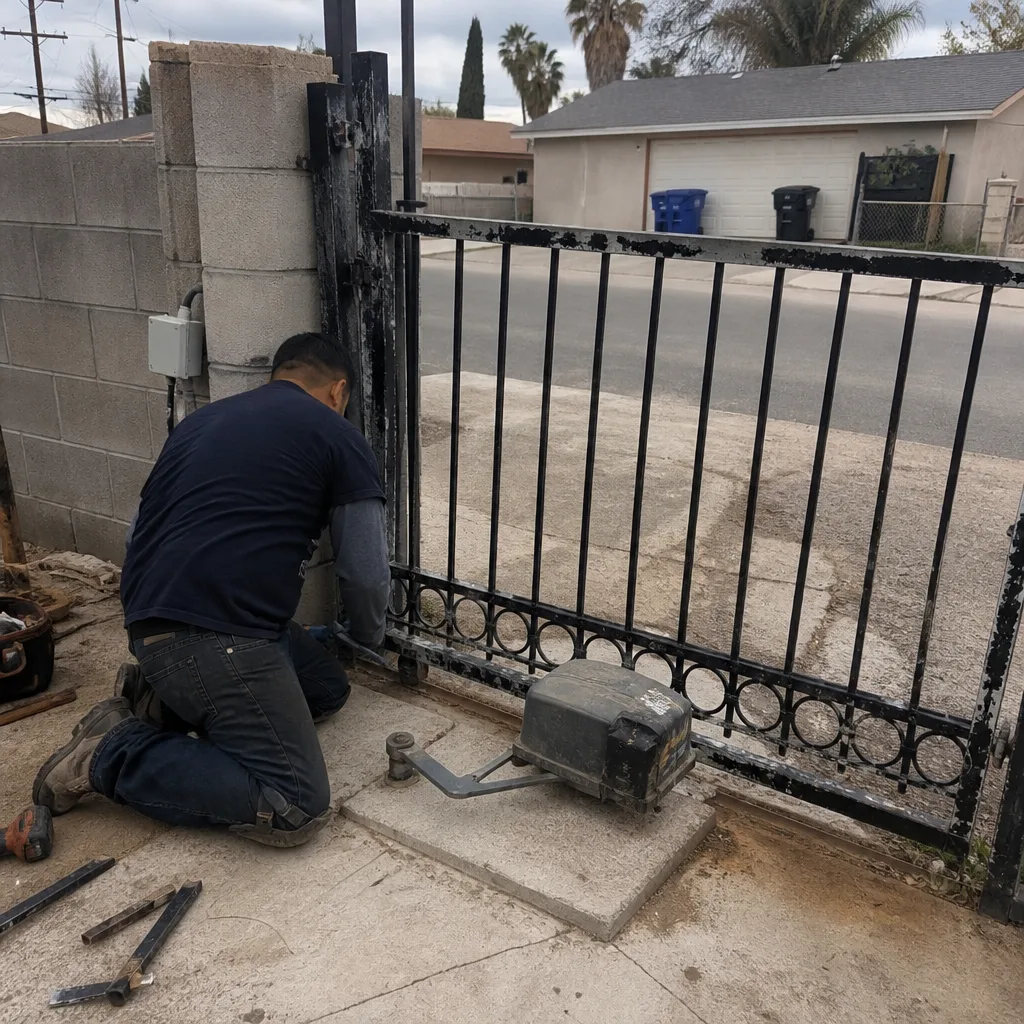 Before
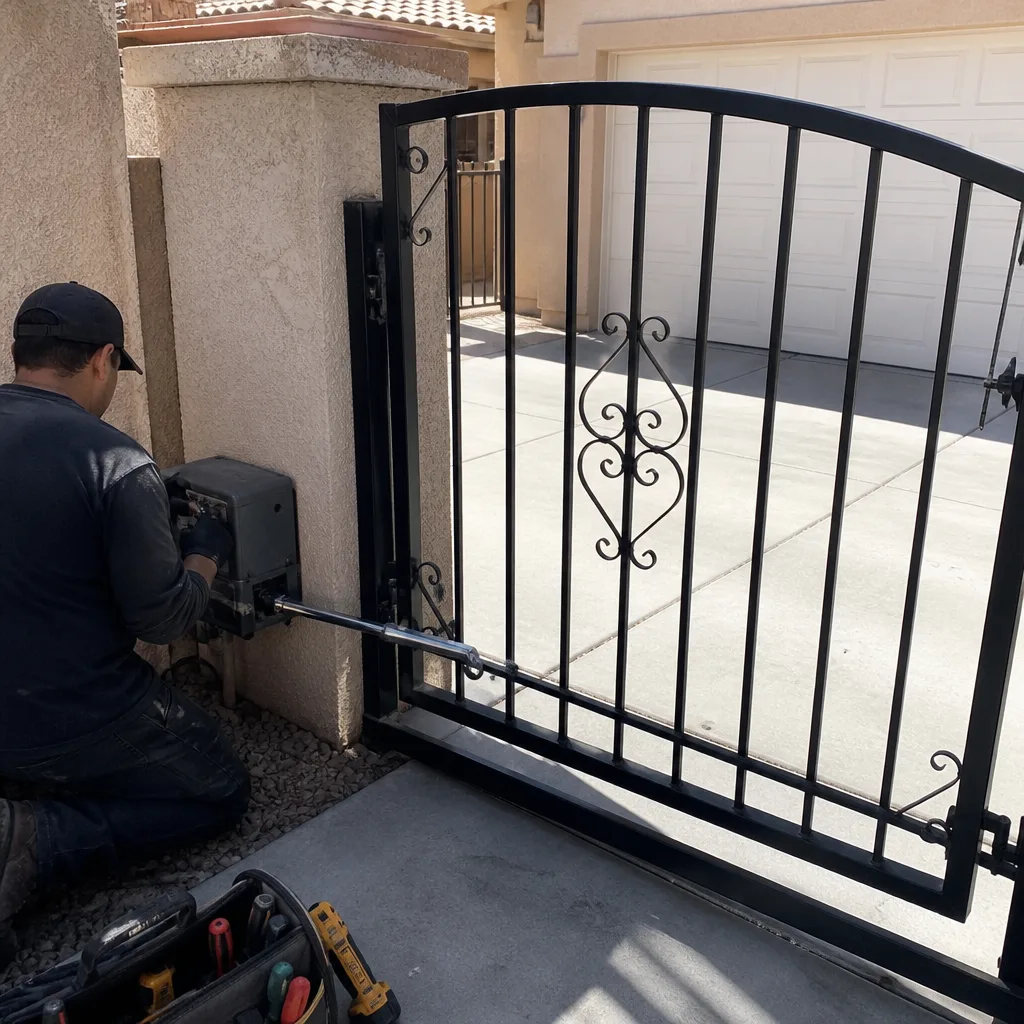
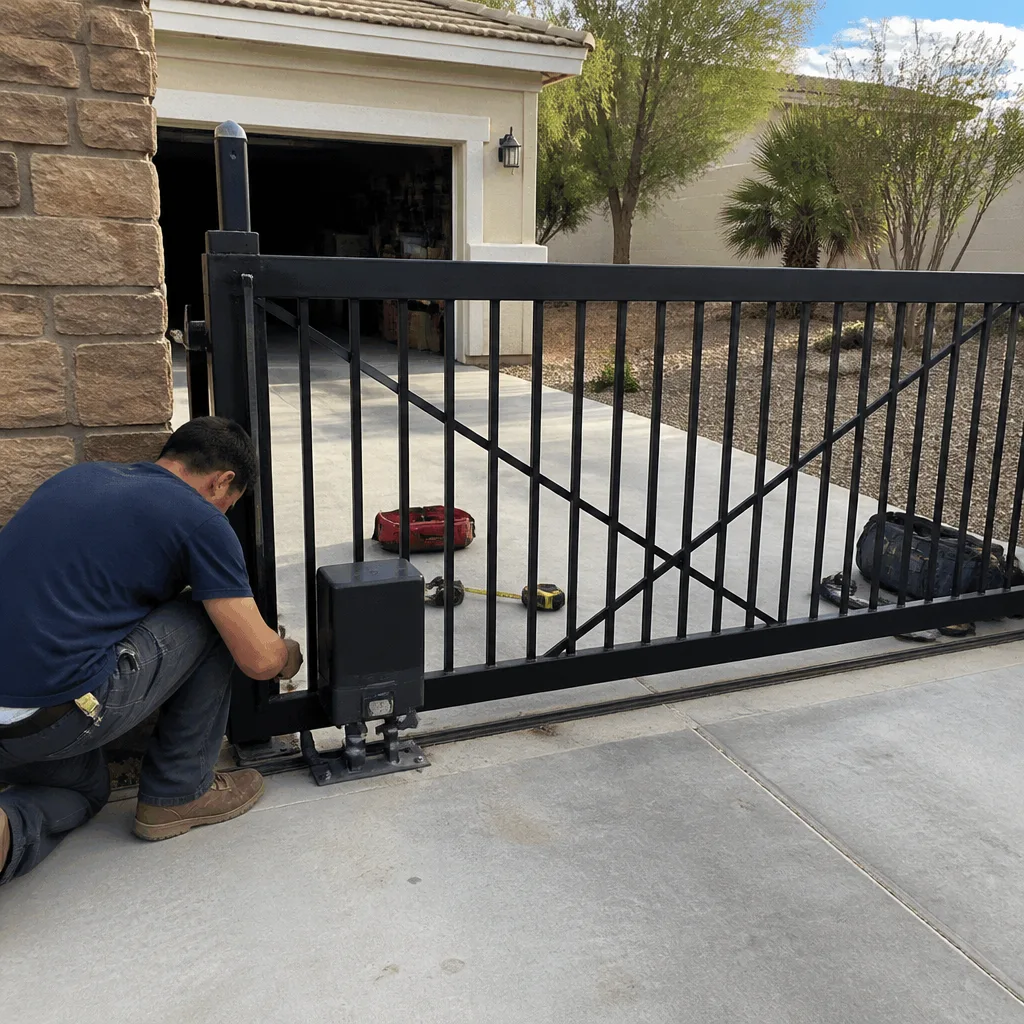 After
After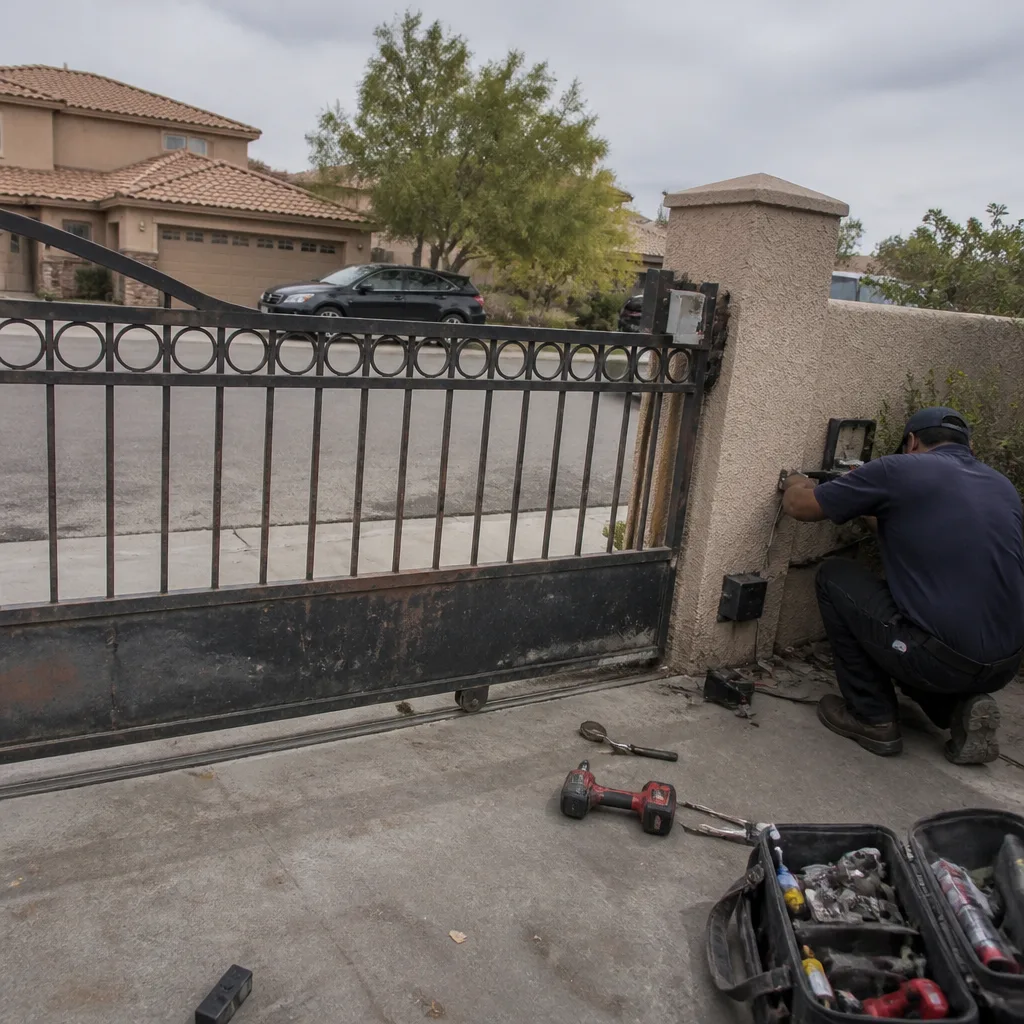 Before
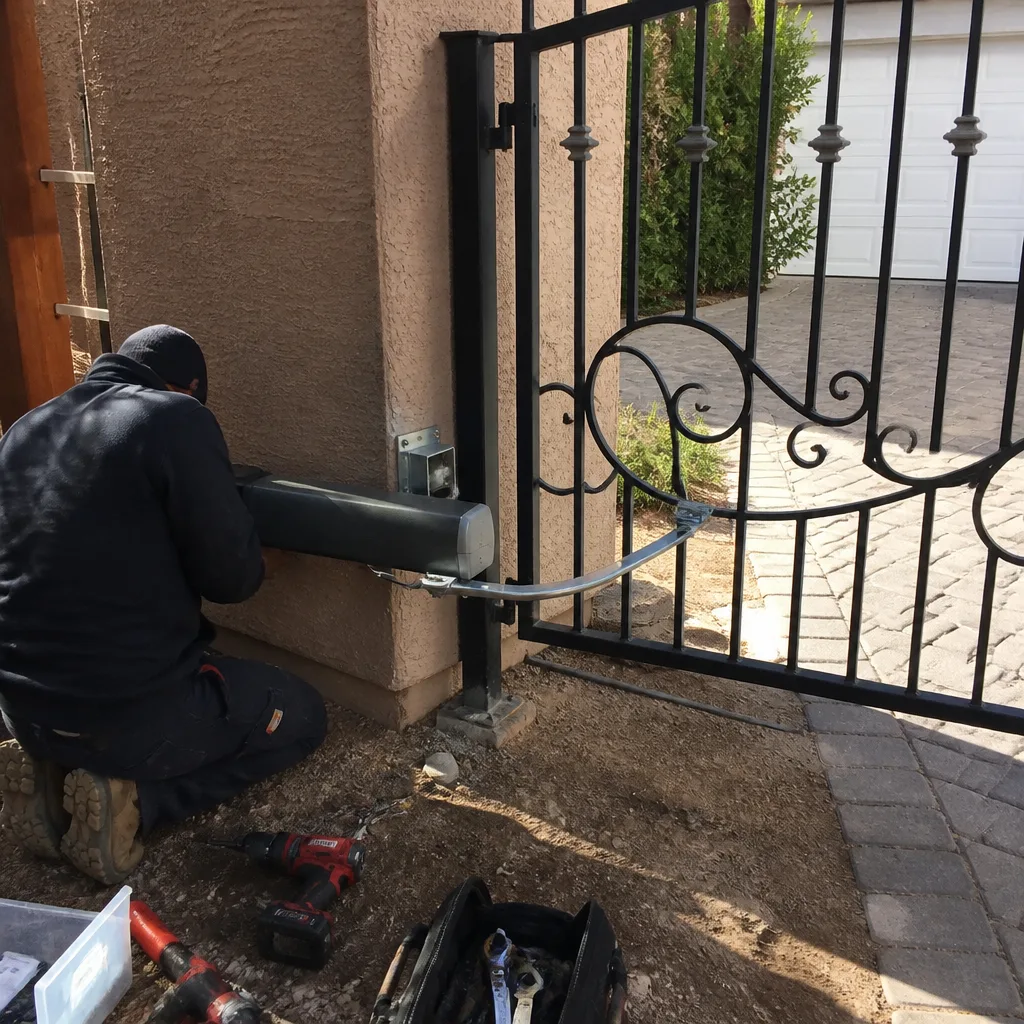 After
After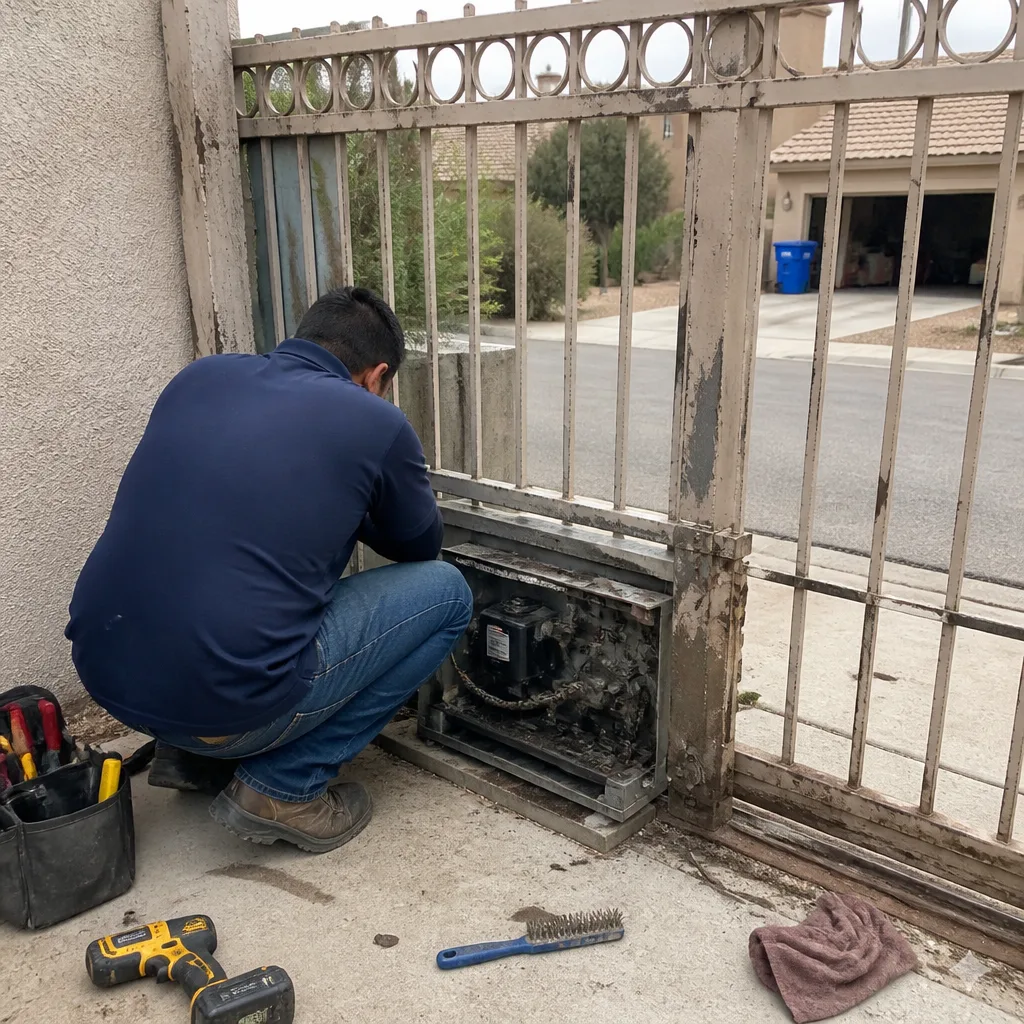 Before
 After
After