
Last updated October 16, 2026
 Wrought iron
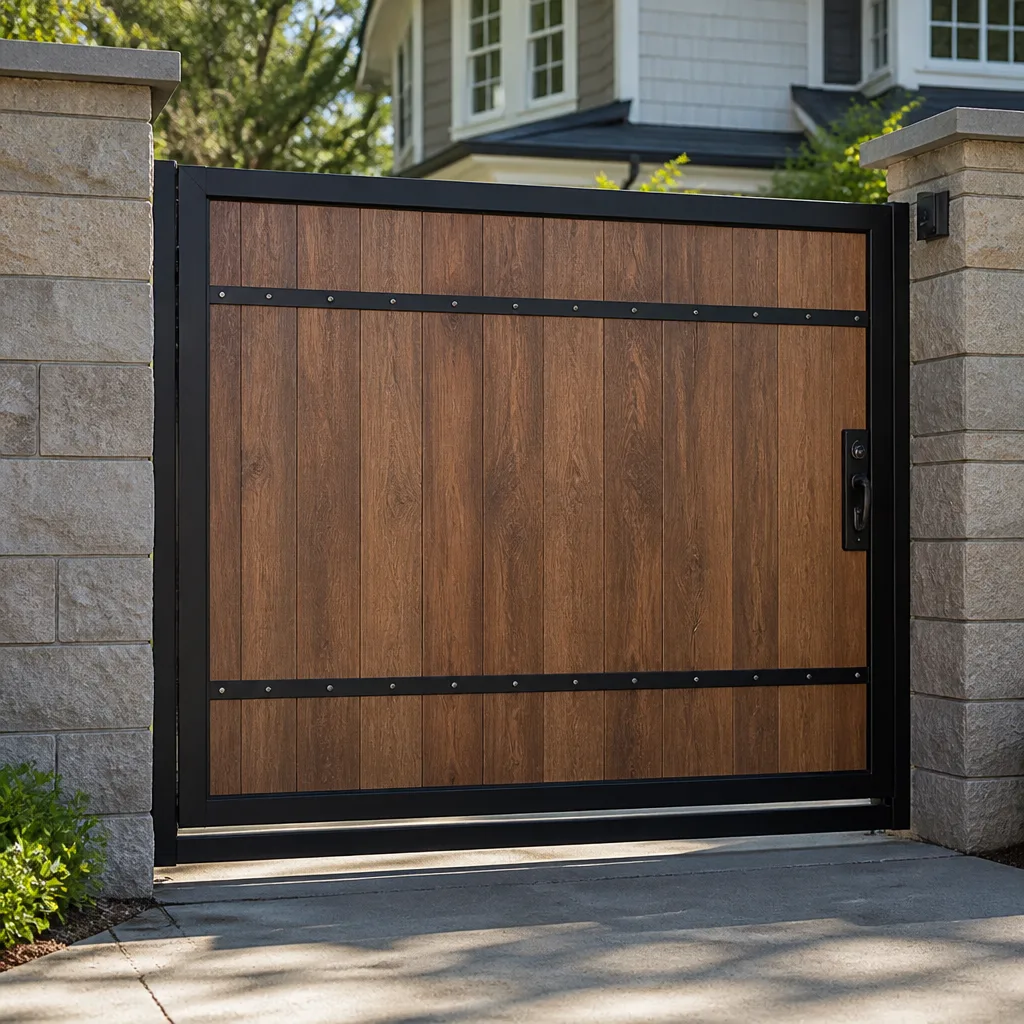 Wood & steel frame
 Farm & ranch
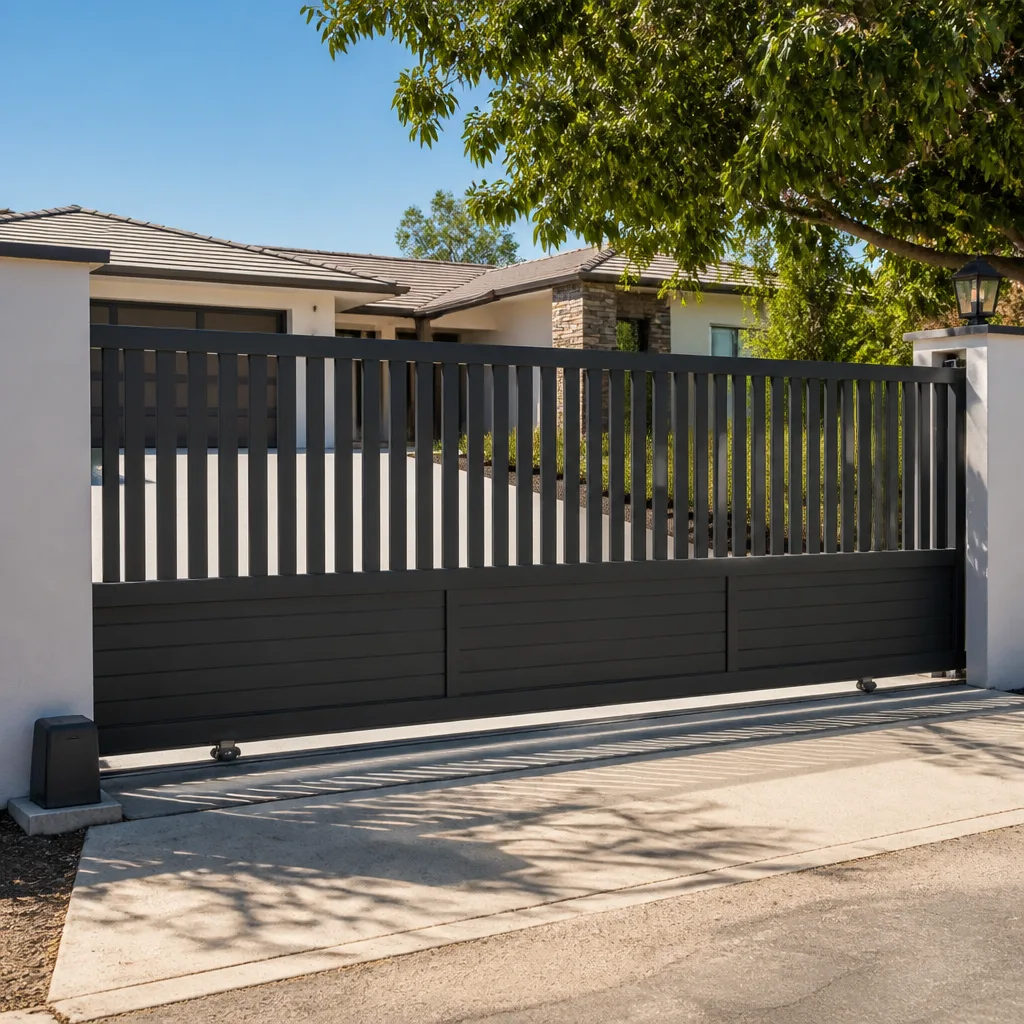 Sliding driveway gates
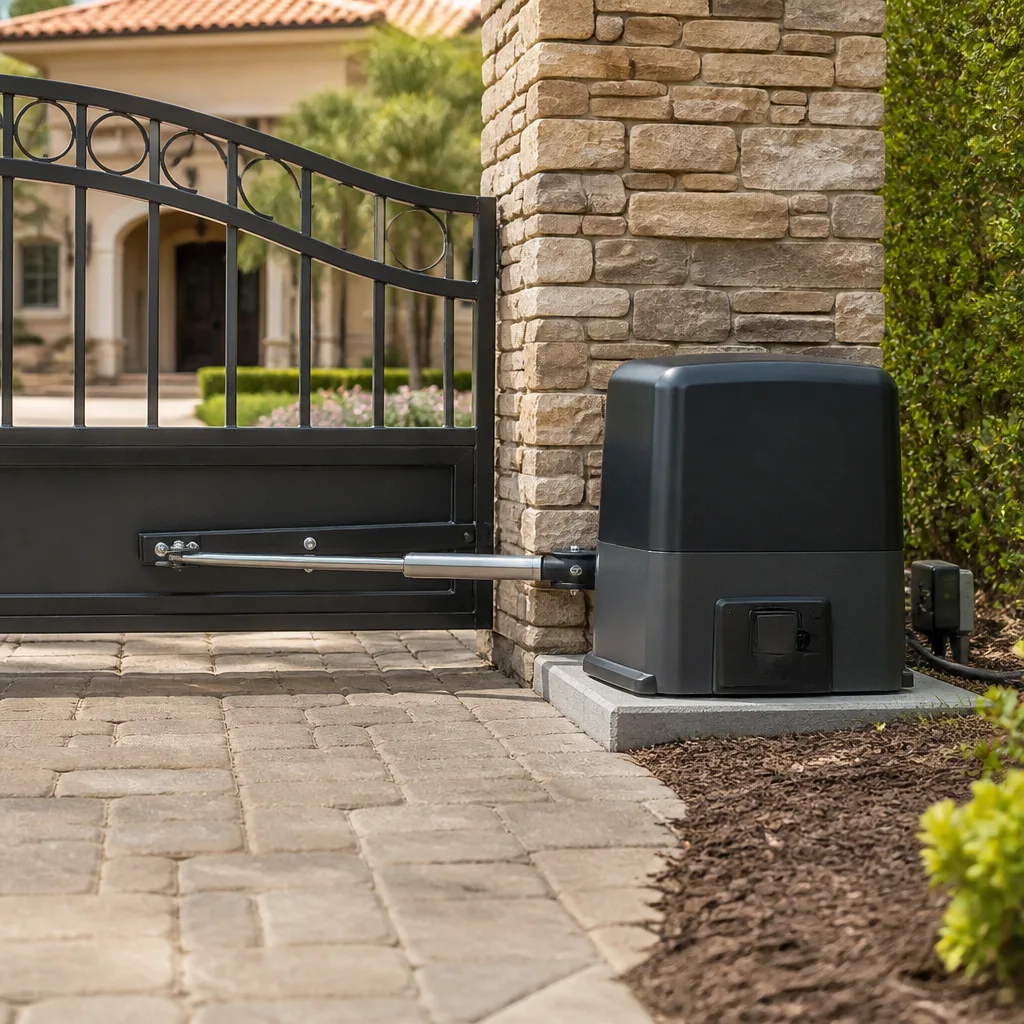 LiftMaster operators
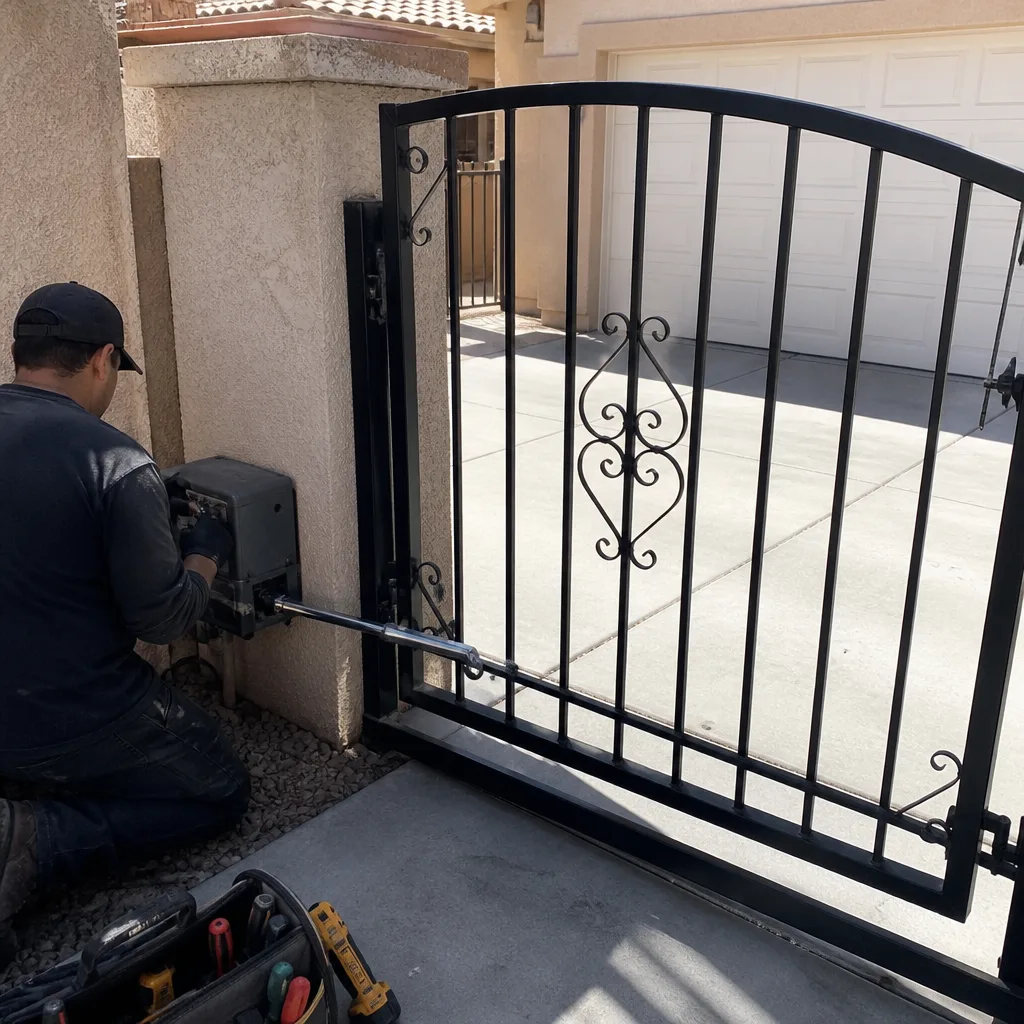
Free on-site gate assessment - hinges, posts, and your LiftMaster or Nice gate operator checked before anything is quoted
The assessment is free and the quote is the invoice.
Get your free estimateGate Repair Permits, Codes & Inspections in NV: What You Need to Know
Most Las Vegas homeowners assume gate repair never requires a permit. That assumption is wrong often enough to cause real problems at resale, during HOA audits, and after insurance claims. The threshold that triggers a Clark County permit requirement is lower than almost anyone realizes, and the moment you touch structural posts or the electrical supply to an opener, you may have crossed it. This guide draws the exact line between what needs a permit and what doesn’t, explains how Henderson, North Las Vegas, and unincorporated Clark County differ, and tells you what to do if previous work was done without one. For Gate Repair Warning Signs: A Las Vegas Homeowner’s Reference Guide, see our dedicated resource.
Quick Answer
Most driveway gate repairs in Las Vegas do not require a permit, but three specific types of work do: structural changes to posts or footings, electrical modifications over certain amperage thresholds, and automation system replacements that qualify as a ‘system change’ under Clark County code. If you’re only replacing a circuit board, a wheel, a keypad, or a broken hinge on an existing gate, you generally need no permit at all. The safest move before any major gate work is a five-minute call to your local building department, and if the work involves high-voltage electrical or structural posts, hire a state-licensed contractor who offers Gate Repair services.
Styles & brands we work with
Table of Contents
- What Gate Work Actually Needs a Permit in Clark County
- What Never Needs a Permit
- Henderson, North Las Vegas, and Unincorporated Clark County: The Differences That Matter
- What Unpermitted Gate Work Does to Your Insurance and Title
- How to Get a Permit After the Fact in Las Vegas
- HOA Approval vs. Municipal Permit: Why You Might Need Both
- What Gate Inspectors Actually Look For
- The Biggest Permit Myths Gate Owners Believe
What Gate Work Actually Needs a Permit in Clark County
Clark County Development Services publishes specific thresholds for gate and fence work, and the line between exempt and permitted is drawn by three things: whether you’re altering structure, whether you’re running or modifying electrical, and whether you’re changing the automation system in a way that qualifies as a system change rather than a like-for-like repair.
The ‘system change’ threshold catches more people than anything else. Replacing a gate opener with the same brand and model is a repair. Replacing a LiftMaster opener with a FAAC or BFT unit, or moving from a swinging gate to a sliding gate, can qualify as a system change under Clark County’s building code, because the code treats the automation as a permanent part of the structure rather than a plug-in appliance. That surprises most contractors, let alone homeowners. If the new opener draws more amperage than the old one, or if the power run changes, you have crossed from repair into modification.
Here is the practical breakdown we use when clients in Las Vegas ask us what will trigger a permit on their gate:
- Structural post work: Any time a post is set in concrete, replaced, or repositioned, a permit is required in Clark County, Henderson, and North Las Vegas. This includes resetting a leaning post, even if the post itself is reused. The code treats the footing as a structural element subject to wind load standards, which in Las Vegas are substantial.
- Electrical connections over specific amperage: Running a new circuit to a gate opener, upgrading from a 15-amp to a 20-amp branch circuit, or installing a dedicated subpanel for gate automation triggers an electrical permit. Replacing a transformer or a low-voltage wire from the opener to the keypad does not.
- Automation system replacement (brand change): Swapping a LiftMaster for a Linear unit, or a FAAC for a BFT, is generally considered a system change when the controls, safety devices, and power requirements differ from the original installation. The inspector’s test is simple: does the new system function the same way the approved one did? If the answer is no, the code says it’s new work.
- New gate installation: Any new gate, whether automated or manual, on a property in Clark County requires a permit if it exceeds 6 feet in height or is automated. That includes driveway gates, pedestrian gates, and any gate attached to a masonry wall.
If you’re repairing an electric gate in Las Vegas, the question to ask yourself before any work starts is: am I changing what’s already there, or am I restoring it? Restoring is exempt. Changing in any material way is not. Most gate opener repairs fall into the restore category, which is why most of our repair calls require no permit at all. But the moment a homeowner says “while you’re here, can we move the post back a foot,” the job changes legally.
What Never Needs a Permit
The majority of door and gate service calls in Las Vegas are exempt from permit requirements, and knowing this saves homeowners from overpaying for permitting they never needed. Here is the list of exempt work, stated plainly:
- Replacing a circuit board, receiver, or control board on an existing gate opener. The opener itself is a repairable appliance when the work doesn’t change its function or power draw.
- Replacing wheels, rollers, hinges, or track components on an existing sliding or swinging gate. These are wear items, and swapping them is maintenance, not modification.
- Replacing keypads, remotes, receivers, photocells, and safety edges. All are low-voltage components.
- Adjusting limit switches, force settings, or travel limits on an existing opener. The switch that tells the gate when to stop needs adjustment over time, and an adjustment isn’t an alteration.
- Rewinding or replacing a spring on a manual gate. If the gate isn’t automated and the post isn’t being touched, there’s no structural modification.
- Replacing a broken weld on an existing gate frame, as long as the gate stays in its original position and no post work is done.
- Repainting, powder coating, or replacing a gate’s decorative cladding. Cosmetic work is outside the code’s interest.
That said, we’ve seen Las Vegas homeowners interpret “no permit needed” as “no code compliance needed,” and that’s a mistake. Exempt work still has to meet the relevant manufacturer’s specifications, and if your gate falls on someone because a repair was done wrong, the absence of a permit won’t shield you from liability. The permit question only tells you what the building department requires. The safety question lives on top of it, and the safety question matters every time the gate moves.
Henderson, North Las Vegas, and Unincorporated Clark County: The Differences That Matter
Las Vegas isn’t one jurisdiction. The city of Las Vegas, the city of Henderson, the city of North Las Vegas, and unincorporated Clark County each run their own building departments with their own application forms, fee schedules, and inspection timelines. The underlying code is the same in most cases, because all four adopt the latest International Residential Code and the National Electrical Code. But the process differs enough that a homeowner who applies in the wrong jurisdiction loses a week or more.
Henderson tends to have the fastest residential gate permit turnaround of the three cities, with some simple over-the-counter permits issued the same day. But Henderson is also stricter about gate setbacks from the right-of-way, and we’ve seen Henderson inspectors flag gates that were set too close to a sidewalk even when the original gate had been there for a decade. The city’s Community Development Department has an online portal where most gate permits can be applied for without an in-person visit, and simple fence/gate permits are often reviewed within 3 to 5 business days.
North Las Vegas has a smaller building department and correspondingly longer queues during peak season, which in Las Vegas runs from late fall through early spring, when the weather allows concrete work. Expect a 5 to 10 business day review on a standard gate permit. North Las Vegas also has specific wind load documentation requirements for gates over 7 feet, and the city will ask for an engineered design on any gate that exceeds that height, even for repairs that involve resetting the posts.
Unincorporated Clark County is where most of the large-lot and rural gate work in the Las Vegas Valley happens, and the county’s Development Services office handles the highest volume of gate permits of any jurisdiction in the state. The county’s portal requires a detailed description of the proposed work, and for automation permits, they’ll ask for the make and model of the opener and the amperage of the supply circuit. If your property is on a county-maintained road, you may also need a right-of-way encroachment permit for a gate that opens outward toward the road. That’s a second application, and it’s one that many Las Vegas homeowners never realize exists until a code enforcement officer brings it up.
The practical takeaway: before you schedule any permitted gate work, ask which jurisdiction your property sits in. A gate contractor in Las Vegas should be able to tell you from your parcel number. If they can’t, call your local building department and give them the address. It’s a five-minute conversation that saves real time later. For help choosing the right professional, read How to Hire a Gate Repair Contractor in Las Vegas: A Step-by-Step Guide.
What Unpermitted Gate Work Does to Your Insurance and Title
This is where the permit question goes from administrative to expensive. Unpermitted gate work in Las Vegas doesn’t sit quietly. It surfaces in three places: insurance claims, property inspections at sale, and HOA architectural audits.
Insurance claims. If an unpermitted gate fails and injures someone or damages a vehicle, the homeowner’s insurer may deny the claim on the basis that the work was not code-compliant. The logic is simple: the insurer priced the risk of the property as it was legally permitted to exist. An unpermitted modification changes that risk, and the insurer didn’t agree to cover it. We’ve seen a Las Vegas homeowner face a $22,000 personal injury claim after an unpermitted gate opener failed and the gate free-swung into a neighbor’s car. The insurance carrier denied the liability portion of the claim. The homeowner paid out of pocket.
Title disclosures and resale. Nevada law requires sellers to disclose unpermitted work on the property. If a homeowner fails to disclose it and the buyer later discovers the unpermitted gate work, the buyer has a civil remedy against the seller. In practice, what happens more often is the buyer’s home inspector flags the gate work, the buyer demands a retroactive permit as a condition of closing, and the seller either eats the permit cost or loses the sale. The dollar exposure is real: we’ve seen unpermitted gate work knock $5,000 to $15,000 off a final sale price in Las Vegas, depending on how much work is involved in bringing it into compliance.
What the code actually says about liability. Clark County treats permits as the mechanism that creates a record of compliance. No permit means no record. No record means the work is presumed non-compliant until proven otherwise. That presumption shifts the burden of proof to the homeowner, and proving code compliance after the fact is always more expensive than a permit would have been on day one.
Here is the sequence we tell our gate repair customers in Las Vegas to think through, in order:
- Figure out if the work needed a permit in the first place. Use the thresholds in this guide, or call the building department and ask.
- If it did, request a permit after the fact (the process below), before you file an insurance claim or list the house. Retroactive permits are common in Clark County and the process is less painful than people assume.
- If the work didn’t need a permit, keep the invoice and any photos. Documentation replaces the permit record in the exempt work category. If a question ever comes up, a written invoice with the scope of work described is your evidence.
- Disclose what you know. If you’re selling and you’re unsure whether the gate work was permitted, the honest disclosure costs less than the lawsuit.
How to Get a Permit After the Fact in Las Vegas
If work was done without a required permit, the fix is called a ‘permit after the fact’ or a ‘retroactive permit.’ Every jurisdiction in the Las Vegas Valley has a process for it, and the process is far more routine than most homeowners expect. The building department’s goal is to bring the work into compliance, not to punish you. Here is the step-by-step process in Clark County and the cities:
- Call or visit your local building department and explain the work that was done and when. They’ll tell you whether a permit after the fact is possible or whether a code enforcement referral is needed first. Most simple gate work goes straight to the permit counter.
- Complete the permit application for the work as it exists now. You’re permitting what’s there, not what you wish were there. The application will ask for the gate’s dimensions, the opener’s make and model, and the type of electrical supply if applicable.
- Pay the permit fee plus a retroactive surcharge. In Clark County and Henderson, the fee structure typically includes the standard permit fee plus an additional fee for the after-the-fact review, which in our experience runs in the low hundreds for a standard gate permit. The exact number depends on the scope and the jurisdiction, so get a quote from the counter before you commit.
- Schedule an inspection. The inspector will come to the property and verify that the work that exists complies with current code. For gate work, the inspection focuses on the items below.
- Correct any deficiencies the inspector identifies. Most deficiencies on gate work are minor: a missing safety edge, a post that isn’t anchored to code depth, an electrical connection that needs a weatherproof enclosure.
- Receive the final permit sign-off. Once the inspection passes, the permit is closed and the work has a compliance record. Keep the sign-off card; you’ll want it if you ever sell.
What inspectors look for on a retroactive gate permit in Las Vegas:
- Post depth and footing diameter relative to the gate’s height and weight, with a specific eye on wind load.
- Presence of UL-listed safety devices: photocells, contact edges, and pressure-sensing edges on automated gates.
- Proper electrical wiring: weatherproof enclosures, GFCI protection where required, correct wire gauge for the amperage draw.
- Gate travel clearances and the absence of pinch points within the pedestrian reachable area.
- For gates that open toward the street, setback distance from the right-of-way line.
If you’re in Las Vegas and the gate work was done on a commercial property or a multi-family parcel, the process goes through a different review track and usually requires a licensed contractor’s signature. For single-family residential work, the homeowner can often permit their own job after the fact in all three cities and the county.
HOA Approval vs. Municipal Permit: Why You Might Need Both
Las Vegas is an HOA-heavy city, and the single biggest source of gate permit confusion we see is the assumption that HOA approval and a municipal permit are the same thing. They are not, and getting one does not satisfy the other.
An HOA architectural approval is a private contractual permission to alter your property in a way that complies with the community’s design standards. The HOA cares about aesthetics: what the gate looks like, whether it matches the neighborhood’s character, whether it obstructs sight lines, and sometimes what brand of opener is visible from the street. The HOA can fine you, file a lien against your property, or force you to remove non-compliant work. Their authority comes from the deed restrictions you agreed to when you bought the home.
A municipal permit is a public regulatory approval that the work complies with the building code. The city or county cares about safety: structural integrity, electrical safety, wind resistance, and pedestrian protection. The city can issue stop-work orders, assess fines, and complicate your ability to sell the property. Their authority comes from state law and local ordinance.
You can have one without the other, and many Las Vegas homeowners do. The typical sequence is: the homeowner gets the HOA approval, assumes the gate is now legal, and discovers years later, during a pre-listing inspection or an insurance claim, that no municipal permit was ever pulled. Or the reverse: the contractor pulls the municipal permit, the work passes inspection, and the HOA sends a violation letter because the gate color doesn’t match the approved palette.
The order to do it right, for any gate work in Las Vegas where both apply:
- Check your HOA’s governing documents first. Find the architectural review section and confirm what gate work requires advance approval. Many HOAs require approval for any gate replacement, even if no permit is needed.
- Submit the HOA application. Do this before you pull the municipal permit, because HOA conditions may change what you’re proposing to build, and you don’t want to pay for a permit on a gate the HOA won’t allow.
- Pull the municipal permit. Once the HOA approval is in hand, apply to the building department for whatever permit the work actually requires, using the thresholds above.
- Keep both records together. The HOA approval letter and the closed permit go in the same folder. When you sell, the buyer’s agent will ask about both, and having them ready makes the transaction faster.
If you’re working with a gate contractor in Las Vegas, ask them explicitly: does your scope include handling the HOA submission, or is that on me? Some contractors handle both, some only handle the municipal side, and the gap between the two is where most of the pain lives.
What Gate Inspectors Actually Look For
If your gate work does require a permit, the inspection is the final step before the work is legally closed. Inspectors in Clark County, Henderson, and North Las Vegas are generally focused on the same core questions, and understanding them ahead of time makes the inspection go faster.
Safety first. The inspector’s primary job on an automated gate is to verify that the gate cannot injure someone. Modern codes require at least two independent safety devices on an automated gate: a photocell or photo beam that detects an object in the gate path, and a contact edge or pressure sensor that reverses the gate on physical contact. If either is missing, the gate fails inspection. Period. We see this constantly on older Las Vegas properties where the gate was installed before the current safety requirements and has never been updated.
Electrical code. The inspector will look at the disconnect switch, the wiring from the power source to the opener, and whether the outdoor electrical enclosures are weatherproof. In Las Vegas, summer temperatures over 110 degrees are normal, and the code has specific requirements for equipment that operates in high-heat conditions. The inspector will also verify that the circuit is properly grounded and GFCI-protected where required.
Structural code. For any work involving posts, the inspector is checking post depth, footing size, and anchoring. Las Vegas wind codes require gates and posts to withstand specific wind speeds, and the inspector’s checklist depends on the gate’s height, weight, and whether it’s solid or open. A solid-panel gate catches far more wind than an open-bar gate, and the footing requirements scale accordingly.
Site-specific checks. The inspector will also verify:
- The gate doesn’t swing over a public sidewalk or into the right-of-way without a separate encroachment permit.
- The gate’s opening direction doesn’t create a hazard for traffic on the street or the driveway approach.
- Pedestrian access gates, if present, are compliant and can be opened without the main gate being open.
- The emergency manual release on the opener works and is accessible from the outside of the property.
We tell every gate opener repair client in Las Vegas the same thing: if the gate is being permitted, treat the inspector’s checklist as the minimum, not the goal. A gate built to code is a safe gate. A gate built to exceed code is an even safer one. The gap between minimum and better is usually small, and it’s almost always worth closing.
The Biggest Permit Myths Gate Owners Believe
We hear these constantly from Las Vegas homeowners, and each one is worth correcting directly:
Myth: “It’s just a replacement, so no permit is ever needed.” Reality: Replacing like-for-like doesn’t need a permit. Replacing with a different brand or configuration may, if it crosses the system-change threshold. When a homeowner swaps a LiftMaster for a FAAC unit, the city’s view is that they’ve installed a new system, not repaired an old one.
Myth: “The HOA approved it, so the city doesn’t need to know.” Reality: The HOA and the city are separate authorities with separate jurisdictions. One approval doesn’t satisfy the other. You can be HOA-compliant and city non-compliant at the same time, and the city’s enforcement tools are the stronger of the two.
Myth: “Unpermitted work is grandfathered after a few years.” Reality: There is no grandfathering of unpermitted work in Nevada. The building department can require a permit on any unpermitted structure or modification at any time, regardless of how long ago it was done. The most common trigger is a code enforcement complaint, an insurance claim, or a title review.
Myth: “The contractor’s license means the permit is covered.” Reality: The contractor’s license is a credential, not a permit. The permit is a separate document issued by the building department. A contractor who does permitted work without a permit is violating their own license conditions, and the homeowner is still the one who answers to the building department.
Myth: “Only new gates need permits.” Reality: Structural post work and electrical modifications on existing gates trigger permit requirements too. The age of the gate doesn’t change the threshold.
Myth: “A permit makes everything expensive and slow.” Reality: For most residential gate work in Las Vegas, a permit costs a few hundred dollars and adds a few weeks to the schedule. The alternative, a problem at sale or during a claim, routinely costs thousands. The math is straightforward.
Common Mistakes to Avoid
- Assuming every gate repair is permit-exempt. Most are, but the exceptions cluster around structural and electrical work. The moment the work involves a post or the power supply, confirm the permit question before the work starts.
- Skipping the HOA review because the city said no permit is needed. The HOA’s process is independent and its own compliance risk is separate. A city exemption doesn’t shield you from an HOA violation letter.
- Hiring an unlicensed operator for structural gate work. Nevada requires contractors performing work over $1,000 in value, or work requiring a permit, to hold the appropriate license. Using an unlicensed operator on permitted work forfeits the state’s contractor recovery fund protections and usually violates the permit’s terms.
- Not keeping documentation on exempt work. Even when no permit is required, a written invoice describing the scope of work dated and signed is your only record if a question comes up later. In Las Vegas, where the resale market is fast and buyers’ inspections are thorough, that record can save a transaction.
- Waiting to disclose unpermitted work at resale. The seller’s disclosure requirement is immediate, and failure to disclose is the kind of error that becomes a lawsuit after closing. Disclose early, and if the work can be permitted after the fact, do it before listing.
- Treating the gate opener change as purely cosmetic. The opener is the automated brain of the gate, and the city treats it as part of the permanent system when the replacement changes functionality. Check the amperage and the brand question before you assume the repair is a simple swap.
- Ignoring the safety device requirements on older gates. Even if your gate never needed a permit historically, modifying it now opens the door to current-code compliance. Adding the missing photocells and safety edges is a few hundred dollars and becomes mandatory once the inspector looks at the system.
See the difference
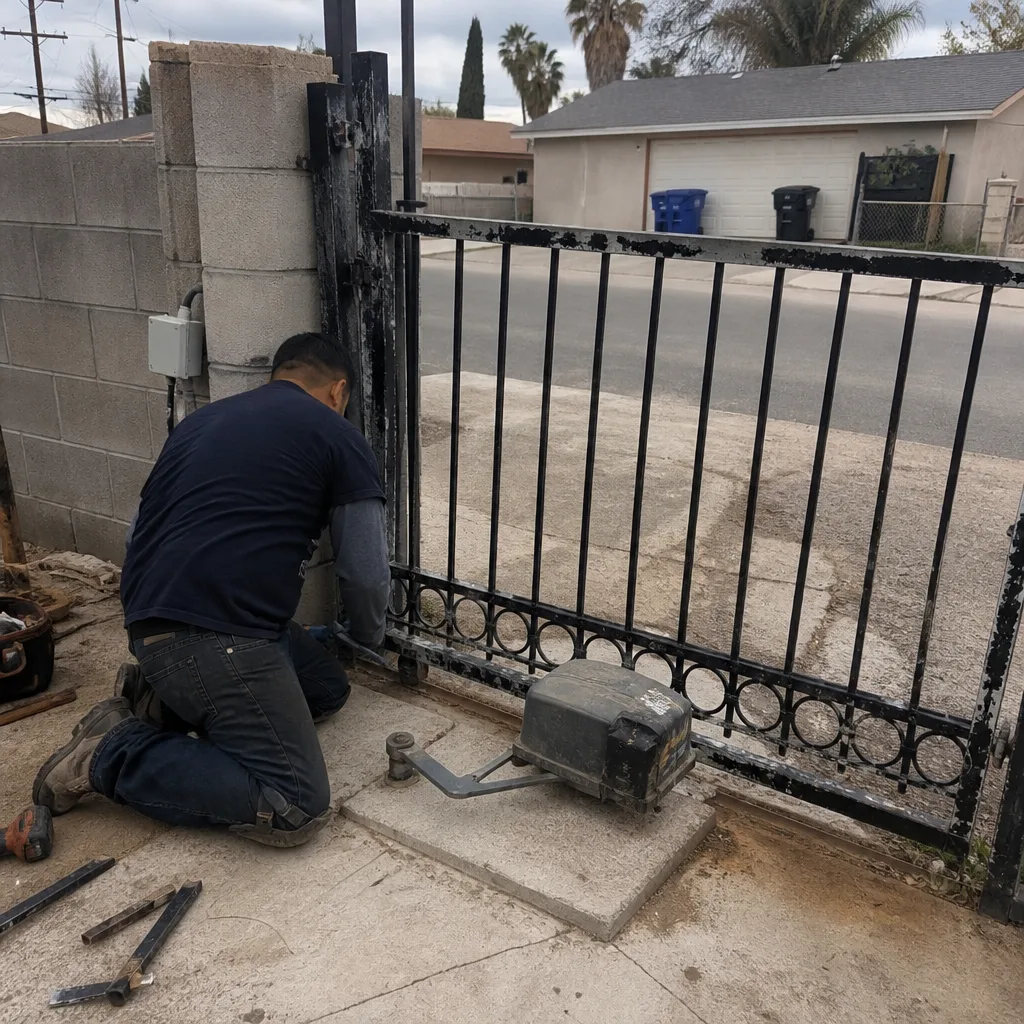 Before
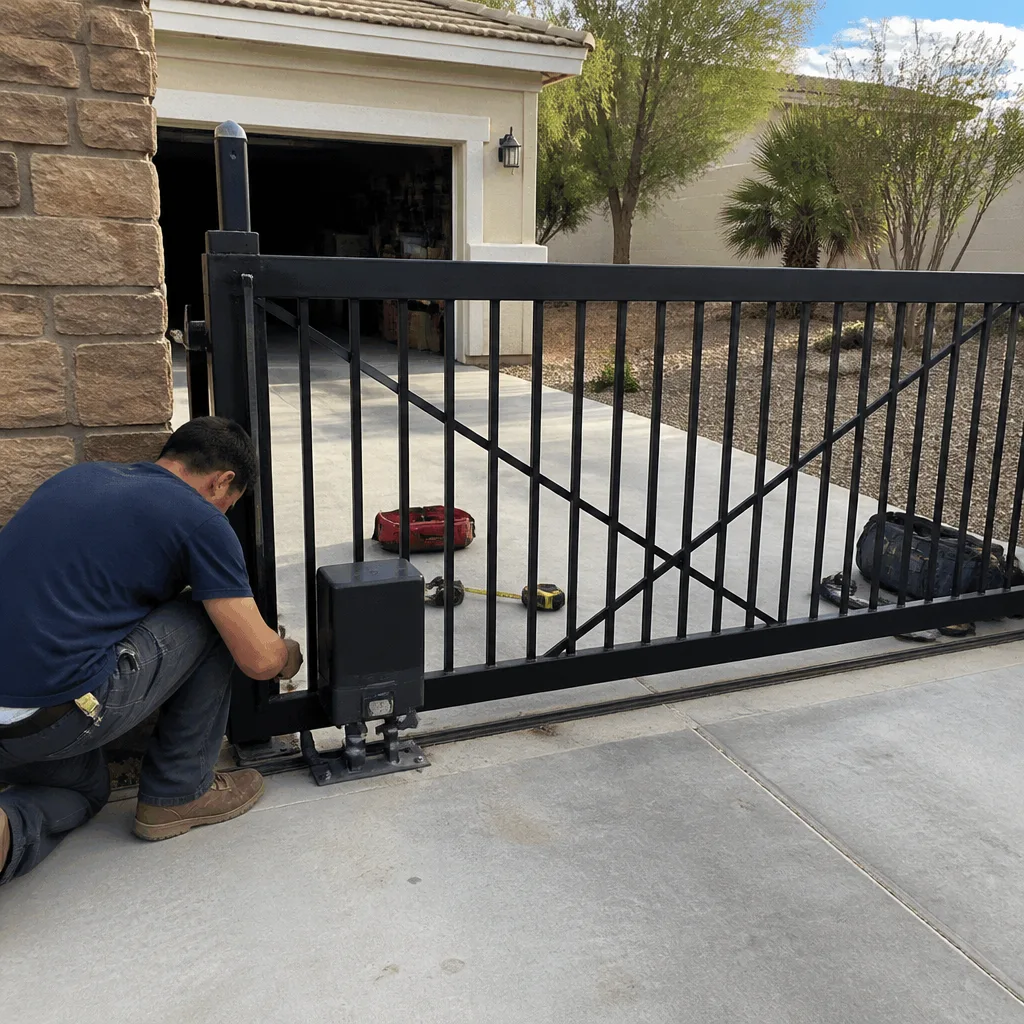 After
After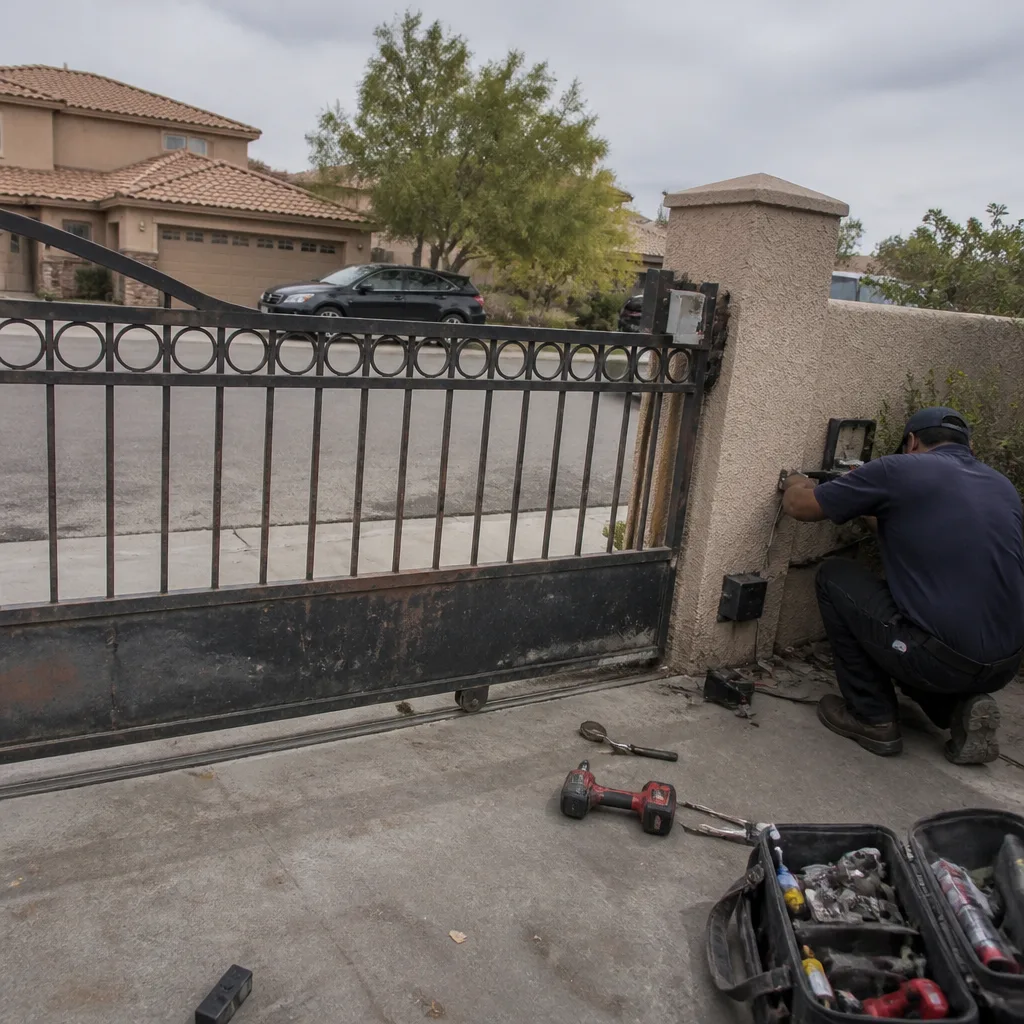 Before
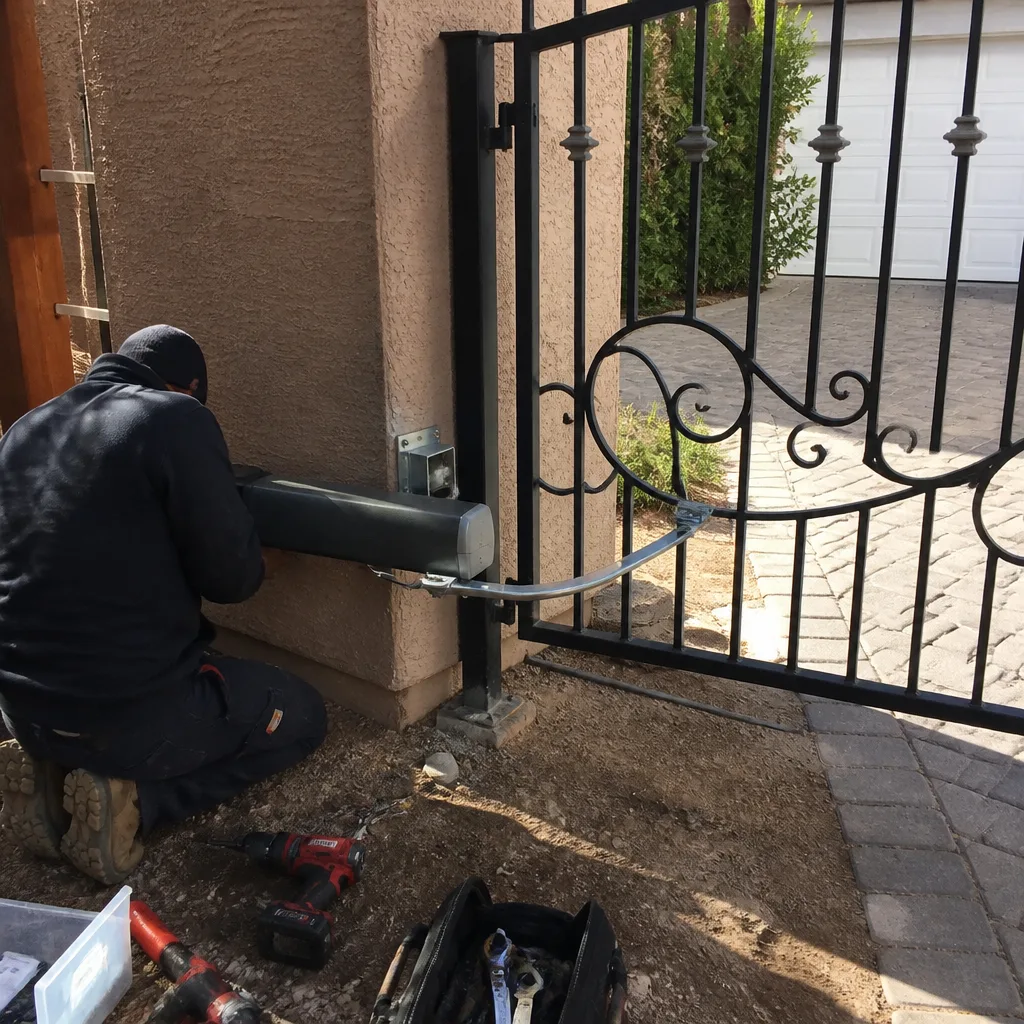 After
After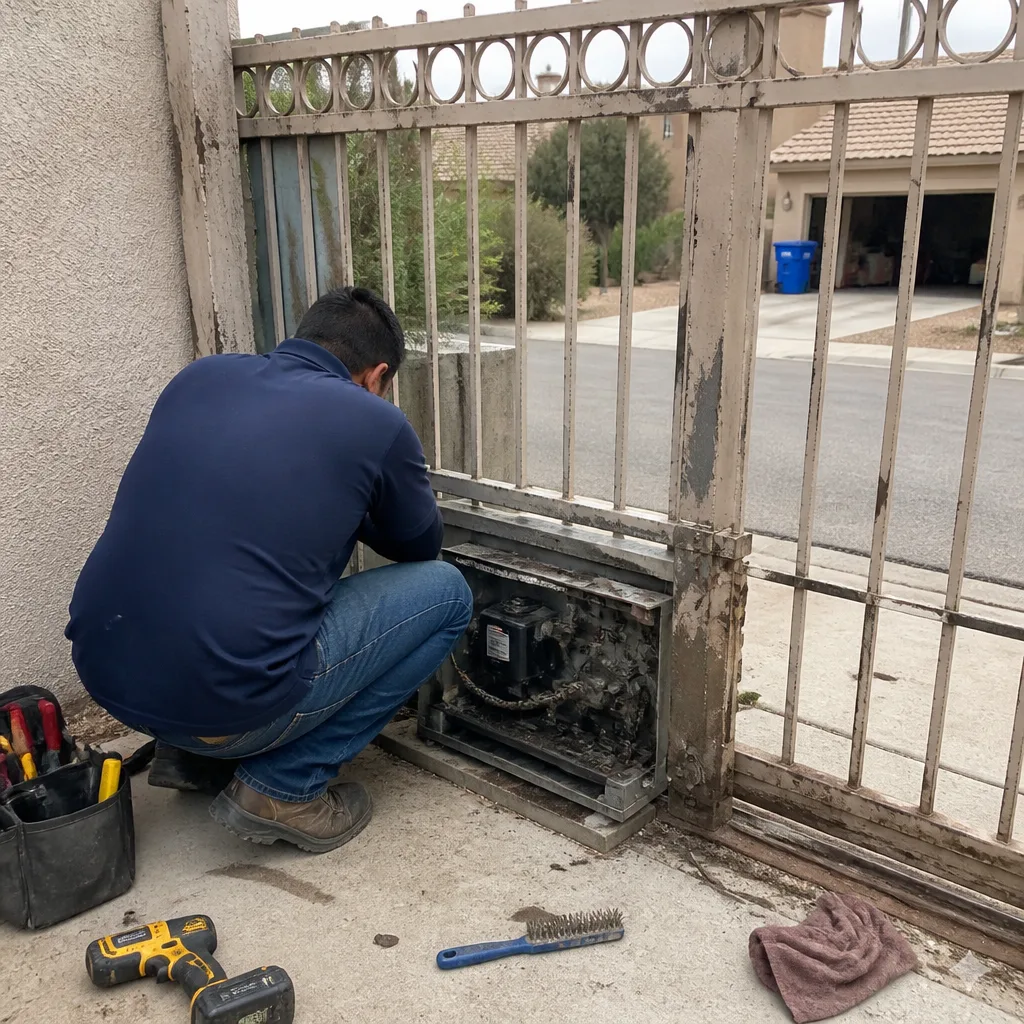 Before
 After
AfterWhen to Call a Professional
Call a professional the moment the gate work involves structural posts, new electrical runs, or an opener brand change that may cross the system-change threshold. This isn’t about convenience; it’s about getting a permit application done correctly and an inspection passed without a re-do. It’s also about the actual danger involved: gate automation runs on significant stored energy, and a gate that closes on someone in Las Vegas is a legal event as well as a physical one. The springs, the opener’s high-tension mechanism, and the electrical supply each carry enough force or current to cause serious injury, and a trained professional knows where that energy lives and how to manage it. If previous unpermitted work is on your property and you need a permit after the fact, a licensed contractor can help you navigate the application and inspection process. Calder Gate Repair Las Vegas offers free estimates in Las Vegas, and we’re glad to tell you whether your gate work needs a permit based on the thresholds in this guide. Call (725) 220-0280.
Frequently Asked Questions
Replacing a gate opener with the same brand and model generally requires no permit in Las Vegas. Replacing it with a different brand, such as switching from LiftMaster to FAAC or BFT, can qualify as a system change under Clark County code and may require a permit. The deciding factors are the new opener’s amperage draw and whether the power supply changes. If you’re unsure, call your local building department and describe the work; the answer takes five minutes. Call (725) 220-0280 if you’d rather have us check it for you.
You disclose it on the seller’s disclosure form, and the buyer may demand a retroactive permit as a condition of closing. Unpermitted gate work that isn’t disclosed can become a civil liability after the sale, and Nevada law gives the buyer a legal remedy against the seller. The fix, a permit after the fact, is routine in Clark County and usually costs a few hundred dollars. Do it before you list the house. Browse our more guides & resources for additional homeowner tips.
No. HOA approval is private contractual permission to alter your property within the community’s design rules. A building permit is public regulatory approval that the work complies with the safety code. In Las Vegas, you can have one without the other, and many homeowners do. For any gate work where both apply, get the HOA approval first, then pull the municipal permit.
A retroactive gate permit in Clark County typically costs a few hundred dollars for standard residential work, including the permit fee and the after-the-fact review surcharge. The exact number depends on the scope of the work, the jurisdiction, and whether an inspection identifies deficiencies that need correction. Call your local building department for a specific quote before you apply, or call (725) 220-0280 and we’ll help you figure out which jurisdiction you’re in.
It depends, but the risk of denial is real. If an unpermitted gate fails and causes injury or property damage, the insurer may deny the claim on the basis that the property wasn’t legally compliant at the time of the loss. The insurer priced the risk on the permitted condition of the property, and the unpermitted modification changes that risk. We’ve seen Las Vegas homeowners pay five-figure claims out of pocket when an unpermitted gate failed.
The brand isn’t the issue; the change of brand is. When a homeowner replaces a LiftMaster with a Linear unit, or a FAAC with a BFT, the system’s power draw and control logic change, and the building department may treat that as new work. The specific brands don’t matter as much as whether the replacement changes the electrical load or the automation’s function. If your repair keeps the original opener’s electrical setup, the brand question is usually irrelevant.
The Bottom Line
Most gate repair in Las Vegas needs no permit. The exceptions are structural post work, electrical modifications over the amperage thresholds, and automation system replacements that qualify as system changes. The most expensive mistake a homeowner can make isn’t paying for a permit they didn’t need; it’s skipping one the inspector later requires, especially at resale or after a claim. If you’re unsure, the cheapest five minutes available is a call to your building department, or a call to us. We’re Calder Gate Repair Las Vegas home to the valley’s gate repair questions, and we’re glad to tell you honestly whether your job is permit-bound or not. If it is, we handle the process from application to inspection sign-off. If it isn’t, we’ll say so and save you the money. Either way, the answer starts with a phone call to (725) 220-0280.
Written by Nico Alvarez, Owner at Calder Gate Repair Las Vegas, serving Las Vegas since 2009.